
It don't make no sense. - Mr. Plinkett
Windows 8 is a great example of the integration of technology into a culture unwilling to actively engage with technology. Simply put, it is symptomatic of the dumbing-down of technology. [1] There is a large difference between increasing usability through an interface, and oversimplifying something to the point of breaking its most fundamental features. Trying to make a desktop computer function in the same way a mobile device does is idiotic. Windows is attempting to emulate the iPad, which only makes me winder why someone would continue to use a Windows PC and not just buy an iPad. Unlocking the computing power in portable devices to make them more useful is progress. Limiting the power of computers to make them look and function like portable devices is backwards. The point of a desktop machine, besides it hardware configuration is the access "under the hood" to be able to reconfigure applications and have direct access to the code, or the file system in order to make things more efficient and productive. Microsoft is doing great advertising work for Apple. We now have apps, tiles and charms. Before it was simply icons and applications and that was good enough. Creating cool names for them doesn't help, it just facilitates the anti-intellectualism involved in the new computing.
As PC World claims that "the unfortunate reality here is that Windows 8 doesn't work as a desktop operating system." Even Paul Thurrott claims "Windows 8 isn’t even Windows anymore. It’s a tablet OS that’s been
grafted onto Windows like a monstrous Frankenstein experiment . . . it is those very users who don’t want or need tablet functionality that
are financing Microsoft’s push towards an OS—that is not really
Windows—that will replace what they’re using."
It seems clear that every alternating version of Windows is a complete catastrophe. Windows 98 was a great improvement over 95 (although 95 brought the PC into a new generation of usability). ME was terrible. Microsoft hit a double target with 2000 and XP, both highly stable and applicable. Vista was annoying (although at least it functioned). 7 seemed to have stabilized and added some evolutionary qualities to the PC. And, with another attempt at a generational leap, 8 seems like the best one to skip.
[1] Notice how other countries have had more advanced smart phones, but here simpler versions have been sold just because Americans don't want to learn how to use their devices. The iPhone may have changed that.
Saturday, November 03, 2012

Saturday, October 27, 2012
Talk Talk
Scanning by Alistair Begg on the radio tonight I heard him discussing the "stupidity" of deconstructionism and the "idiocy" in the "ivory towers" of those in the field of postmodernism. Now, I have to give him credit for bringing up these concepts - where else can anyone hear about them publicly? Unfortunately, I imagine his audience doesn't have a clue what he's talking about. To reduce these movements of thought to the terms stupid and idiotic is, at best, lazy and at worst deceptive. It shows his own lack of vocabulary. For someone so interested in language in order to propagate his message, he should be more interested in how language works. Does he think the word of God was handed to us in modern English in completely unambiguous terms? The answer is, of course, yes. And this shows his own stupidity and idiocy. He proceeds from the premise that every word and phrase in the Bible has a singular, immutable meaning. At which point his work diverges from any intellectual pursuit.
First, given the unending amount of religious media, the massive amount of religious denominations (along with their internal conflicts), the history of religious wars, and the endless "talk" (babble) about this passage and that, its clear that there is no center of Biblical interpretation. There are as many interpretations as there are readers, and it is constantly reinterpreted in new light. Otherwise, he would be out of a job and everything would have been decided two thousand years ago. Second, it is clear that language is a construct of humanity that continues to evolve and that we operate only with concepts found inside this construct. So, even if the original authors intention was to relate a directly perceived truth, it had to be "encoded" into the language of the time, reduced from a pre-language meaning. And that meaning has been re-translated though history into new languages as they come into existence. So, what we have now is a multi-generational copy of the original thought. Further, there is no indication that the Bible was intended to be such a precise, narrow vision. Given the factual and logical contradictions that are constantly present, if that was the intention then it is a complete failure. Alistair's problem is that since he operates from that illogical premise there is no way to reason with what he saying, he has closed off any possibility of negotiating a new and improved conclusion. He condemns the intellectuals, but since he doesn't work in the rational field of the intellect, he is not proving their arguments to be invalid. It is comparing oranges and apples, and all he can do is resort to name calling.
Begg can denounce the deconstructionist for removing meaning, the postmodernist for rejecting the meta-narrative and the atheist for rejecting the existence of God. But even if this group of miscreants were to proceed without any arguments, reason, or evidence (in the worst un-intellectual case), all they would be doing is coming down to his level - operating from a presumed premise based on belief. Deconstruction and postmodern thought do not state that anything can mean anything (or nothing), they only reveal the internal contradictions, ambiguities and multiplicities that are inherent in human thought and magnified by the limitations of language. I understand that Begg wants to believe in a transcendental signifier and must be concerned with the deconstructionists' lack of belief in one. But, if he wants to discuss deconstruction then he needs to do it on their terms and argue convincingly why there is a transcendental signifier that gives a pre-established meaning. Calling it stupid is not nearly enough. Perhaps he could start by reading Who's Afraid of Postmodernism and Postmodern Theology. On second thought, maybe its best if he didn't discuss these concepts, as he only promotes misinformation that may be blindly accepted by his audience.
Sunday, October 14, 2012
No, you're not entitled to your opinion
In No, you're not entitled to your opinion, Patrick Stokes argues (quite well) that not all opinions are the same. It is not enough to say that I have my opinion and you have yours. There has to be some reason, and as he states: "you are only entitled to what you can argue for." Allowing every possible opinion to be right makes all views correct, and therefore nothing is more true than everything else and we end up in nihilism. Relativism in morality is difficult enough (and presents problems even for us non-absolutists) but add extreme relativism into aesthetics and knowledge in general and the whole idea of truth is destroyed. Opinions (at least about the external world [1]) must have some correspondence to reality and its facts. Furthermore, views- if anywhere near complete and worth holding- must hold some level of rationality that can be argued for. If one wants to support a right wing candidate because of belief in the super-capitalist view of trickle-down economics, then one must be able to argue why that is the correct course of action (and be able to overcome contradictory evidence found in the facts of data). Otherwise, your "opinion" cannot be taken seriously.
[1] As Stokes notes, there are matters of taste which involve matters pourely internal to oneself. What do I like better? - chocolate or vanilla? But this is of no consequence to anyone else. If we are to have discourse with anyone outside of ourselves - then we have to invoke criteria to evaluate competing statements in order for them to have any meaning at all.
Friday, September 28, 2012
Grand Designs
I:
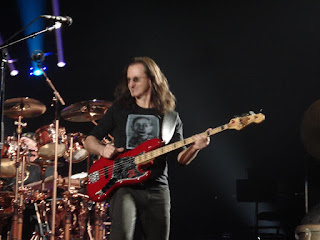
Rush @ Target Center, Minneapolis, MN, 2012.09.24
On this tour, Rush presented a different kind of setlist, (to the disappointment of the narrow-minded 70s fans) that included a lot of mid-80s tracks along with nine tracks off the new album Clockwork Angels. I would have liked a little more late-80s material (which was rotated on an alternating setlist), and I think there was still too much old material. The addition of the orchestra added more than I though it would, particularly on Manhattan Project, and it was interesting to the members integrate into the band and the rock-show.
+ : Subdivisions, Force Ten, Manhattan Project, Bravado
- : 2112, omissions of The Pass, Dreamline
View from the front row:


Part II:
As for Clockwork Angels, I haven't been able to get a handle on it for a couple of reasons. First is the brickwalled sound. Production-wise, this is Vapor Trails III, with each sequel getting heavier. I find it incredibly fatiguing to listen to. Additionally, so many of the tracks are so similar in tempo and structure that it sounds like one long song. At most I can only listen to half of the album. The Garden stands out a little bit, but there really isn't much variety. Furthermore, the triple-tracking pattern for the guitars and bass that they have adopted over the last three albums is just too much. Lyrically, its a bit too progressive in my opinion. It's far too dense and sci-fi-ish. This would almost work better as a book (oh, wait. It is). There have been criticisms on how thin the lyrics were on Presto (and in a few lines this is true, although it became far worse on the insipid and shallow Test for Echo). But here the density of the story put into verse is just too much, especially when combined with the density of the music. It also includes the worst, most vacuous phrase in English "it is what it is." I'll give it a little more time, but I'm hoping for a change of sound for the next album.
Rush @ Target Center, Minneapolis, MN, 2012.09.24
On this tour, Rush presented a different kind of setlist, (to the disappointment of the narrow-minded 70s fans) that included a lot of mid-80s tracks along with nine tracks off the new album Clockwork Angels. I would have liked a little more late-80s material (which was rotated on an alternating setlist), and I think there was still too much old material. The addition of the orchestra added more than I though it would, particularly on Manhattan Project, and it was interesting to the members integrate into the band and the rock-show.
+ : Subdivisions, Force Ten, Manhattan Project, Bravado
- : 2112, omissions of The Pass, Dreamline
View from the front row:


Part II:
As for Clockwork Angels, I haven't been able to get a handle on it for a couple of reasons. First is the brickwalled sound. Production-wise, this is Vapor Trails III, with each sequel getting heavier. I find it incredibly fatiguing to listen to. Additionally, so many of the tracks are so similar in tempo and structure that it sounds like one long song. At most I can only listen to half of the album. The Garden stands out a little bit, but there really isn't much variety. Furthermore, the triple-tracking pattern for the guitars and bass that they have adopted over the last three albums is just too much. Lyrically, its a bit too progressive in my opinion. It's far too dense and sci-fi-ish. This would almost work better as a book (oh, wait. It is). There have been criticisms on how thin the lyrics were on Presto (and in a few lines this is true, although it became far worse on the insipid and shallow Test for Echo). But here the density of the story put into verse is just too much, especially when combined with the density of the music. It also includes the worst, most vacuous phrase in English "it is what it is." I'll give it a little more time, but I'm hoping for a change of sound for the next album.
Sunday, September 23, 2012
Duluth Airshow 2012
Duluth IAP, MN, 2012.09.22
This year's airshow was very scaled back. There was no Air Force or Navy support (The F-16 demo team came to fly a few passes in the heritage flight - the gas, pilots and airframes were paid for - so if anybody can explain the AF's demo team stand-down to me, I can't figure it out), and the 148th didn't even fly, being mostly deployed to Afghanistan. That left the Marine's AV-8 demo, F-4, and the Canadian snowbirds. Statics were very light including the F-16, EF-18G, F-18, T-38, C-130 and the impressive C-5A. Weather was 37 degrees with high wind and rain, making quite a contrast to this summer.


Full Album
This year's airshow was very scaled back. There was no Air Force or Navy support (The F-16 demo team came to fly a few passes in the heritage flight - the gas, pilots and airframes were paid for - so if anybody can explain the AF's demo team stand-down to me, I can't figure it out), and the 148th didn't even fly, being mostly deployed to Afghanistan. That left the Marine's AV-8 demo, F-4, and the Canadian snowbirds. Statics were very light including the F-16, EF-18G, F-18, T-38, C-130 and the impressive C-5A. Weather was 37 degrees with high wind and rain, making quite a contrast to this summer.


Full Album
Thursday, September 13, 2012
Sound That Can't Be Made
Sounds That Can't Be Made - Marillion
"People change and they turn strange and so will I"
After the longest pause in output in Marillion's career, album 17 - Sounds That Can't Be Made has finally been finished. (Thanks to Marillion for providing me with the Mp3 album while my CD makes a transatlantic journey). Not being the biggest fan of the 2008 release Happiness is the Road, I have not committed as much time to absorbing the latest Marillion works, although I think 2007's Somewhere Else is an amazing record and is holding up as some classic Marillion work. There were difficulties with writers block as it seems that H has already said a lot of what he has to say, although it would seem unfortunate circumstances in his personal life have given him more to say. Even though there are many thematic repeats in his writing career, I think H is good at expressing the same stories in different ways. Some of the problems with making this record, I think, involve the 20 songs put onto Happiness is the Road. I would rather see single disc releases like this that take time than a massive and quick output. To begin with, Sounds has a title that is in my opinion is a bit awkward. I would have preferred something with a little more mystique, something simple like "Rain" would have been nice (there can't be enough Marillion songs about death and water.)
"Nothing's ever simple - that's for sure
There are grieving mothers on both sides of the wire"
"With the love of our family we can rise above anything
Someday surely someone must help us"
The standout track seems to be the opener Gaza - musically heavier and jarring, although somewhat disjointed. However I think this track is Marillion in top form, I can't get enough of it. From the orchestral beginnings, to the distorted guitars to the ethereal vocals this song is a dramatic story. Lyrically, this song has already produced heated controversy. People want to see it as anti-Isreal/Pro-Palestine/pro-terrorist. But I think this is to add a political/historic narrative that isn't present. This is rock music. This is art. This is revolution. It's about an oppressed population living in a war zone, particularly from a more innocent viewpoint. Really the controversy can only come from the title. Without a location name, it could be about any war. The meaning is not far from the Police's Invisible Sun, a song that only generated controversy from the British government. It is surely less ideological than Roger Water's anti-war songs like Leaving Beirut. H comes from a culture that is the dominant in a violent political conflict. Likewise, I, and many offended listeners from America, live in the dominant culture of a conflict. I don't want to see the US lose the "war on terror" and I don't think H wants the IRA blowing up London. But I think that we can look at reasons why these conflicts continue and understand that there are losers on both sides.
"Love had died but love is gonna live again"
Lyrically, the album as a whole is fairly simple and straightforward without much complex metaphor. Power is a strong track and was a welcome addition to the 2012 US tour, although I feel like some of the lyric/vocal transitions are a bit awkward. Pour My Love is a very nice track, a sad theme but presented in a positive and calm manner. It reminds me a bit of Prince (without any funk). Sounds That Can't Be Made , Montreal, Invisible Ink, and Lucky Man are perhaps less memorable lyrically but musically strong. The Sky Above the Rain presents another simple tale of lost love, it's not as epic or moving as I was led to believe, but it is well crafted and has great bluesy guitar work by Rothery.
There is in fact a lot of classic Rothery guitar sounds throughout the record. After their releases in the early 2000s I was beginning to worry that this had become history, but it is back in force. In all instrumental respects this album is musically intriguing and of sound quality. Musical phrases on this album leave me thinking about songs like Out of This World, The Space, Fantastic Place, This Strange Engine, Quartz and much of the Brave album. Although there are only eight songs, the album is 70 minutes long. There are a lot of musical bits, many of which I would like to see explored in longer sections. To be fair, I should give this album a few more weeks of listening before making judgements. But as I can't stop listening to it, I think that's good sign that this album will make its mark and overturn any disinterest I was beginning to feel with the last release. I can't wait for the next one.
Tuesday, September 04, 2012
The Beginning is the End is the Beginning
http://www.newyorker.com/online/blogs/books/2012/08/promiscuous-reading.html
http://www.nybooks.com/blogs/nyrblog/2012/mar/13/why-finish-books/
After reading these two articles, I got to wondering about the importance of finishing books. I try to read only one at once so that I can finish it without being promiscuous, but occasionally I don't finish one and this leaves me with great feelings of guilt and failure. But, should that be so? The information age has reorganized information into discreet units and changed these units at the fundamental level. It has shown us, for example, that the album does not have to be the proper unit of music, the track itself can now stand on its own. When a work is cognitized and placed into our mental warehouse of information is the linear nature of beginning, middle, and end a necessary part of that experience and of that information? After watching a movie, the significant elements might just be a scene or two, or even a line of dialogue. Perhaps just he visuals of the cinematography are important. Unless a story centers on beginnings or endings, the start and end can seem a bit arbitrary anyway, especially in the era of ongoing sequels. And, in the postmodern age, non-linearity becomes more interesting, as re-juxtaposing scenes in a "random shuffle" fashion becomes a more significant element of form. When viewing a painting it doesn't always seem necessary to understand the entire story and context. Just seeing a depiction of a particular world is sometimes enough. It seems plausible that this can be transposed to the world of text and just comprehending the world created might be enough.
Of course, non-fiction works present more problems. Hopefully the author develops a progression of propositions that lead to a conclusion. However, it is rare that most works follow that form, even in modern philosophy. The thought process is often obscured and not as organized as it should be. Perhaps, if done correctly, each chapter can stand as discrete element of discourse. Furthermore, just by reading a significant insight found within a book, a useful conception might be formed in one's database.
I don't think I can change my practice of finishing works. But, in a universe formed by an ever-expanding plurality of perspectives, it seems that the future of information may involve reduction to significant and discreet points.
Thursday, August 02, 2012
Player One
Last Book Read: Player One - Douglas Coupland
"You can have information or you can have a life. You can't have both."
"Time is the fire we burn in." - Soran, Star Trek: Generations
Although Douglas Coupland has missed the mark with some of his later works, Player One seems to be a logical extension of the thought process he began with Generation X. Once again we are confronted with contemporary existence, as hyper-concious characters living in the margins of society contemplate individuality and meaning in the new superficial world. And once again we are presented with an apocalyptic event without explanation. What once seemed like a quirky and surreal diversion in his early works, now becomes clear as a central theme in the world Coupland is trying to reveal. In his vision of a "Life After God", meaningless and sudden catastrophe become a replacement for a purposeful intervention by God. Reading this book amid news reports of a bleak economic future, Coupland's view of a sudden jolt of society into a "new normal" no longer seems like fantasy. In a world that has become completely superficial, absurd events seem like the only way to force one to contemplate their place in the universe. In this way I see Coupland not far from Camus, portraying the absurdity of life in relation to violence and death in works like The Plague.
This book is perhaps Coupland's most post-modern work, touching on themes such as the spectacle in consumer society, hyperreality in "no places" like airports, and meaningful life as as a complete narrative (or the lack of one). Two themes seem to emerge as the most significant as the book asks the question: How is life played out? First is the nature of the human self. What makes a person who they are? Is it just neurological processes which revolve around defects in functioning mixed with pop-culture influences? Is individuality really just a propagated falsehood as postmodernism suggests? Here, Coupland uses interesting character traits in the autistic, geek Rachel [1] and in opposition refers to characters who have Alzheimer's disease which very literally erases who they are. Second, the book constantly contemplates the nature of time. Does time exist as a dimension so that one can experience a life among events? Written as a real-time five hour story, the book does break from linearity with Player One's viewpoint from "no time." It also breaks from traditional narrative, lacking much in the way of a beginning, middle, and end. Rather it mixes time to show that eternity, infinity, and a whole life can be experienced in the matter of seconds or minutes.
When it comes time to remember what life was like before and during the transition to the new-normal postmodern, post-9/11 world, I see no better record keeper than Coupland, and I already miss the colorful and discreet world that existed as we entered the period of Generation X before the subsequent mixing of everything into a homogenous blandness. In the new virtual and connected information world we are all "Player One", but will we continue to be players in our own lives?
[1] Rachel plays on the 21st century coolness of geek culture, much in the way the Sheldon from The Big Bang Theory does.
"You can have information or you can have a life. You can't have both."
"Time is the fire we burn in." - Soran, Star Trek: Generations
Although Douglas Coupland has missed the mark with some of his later works, Player One seems to be a logical extension of the thought process he began with Generation X. Once again we are confronted with contemporary existence, as hyper-concious characters living in the margins of society contemplate individuality and meaning in the new superficial world. And once again we are presented with an apocalyptic event without explanation. What once seemed like a quirky and surreal diversion in his early works, now becomes clear as a central theme in the world Coupland is trying to reveal. In his vision of a "Life After God", meaningless and sudden catastrophe become a replacement for a purposeful intervention by God. Reading this book amid news reports of a bleak economic future, Coupland's view of a sudden jolt of society into a "new normal" no longer seems like fantasy. In a world that has become completely superficial, absurd events seem like the only way to force one to contemplate their place in the universe. In this way I see Coupland not far from Camus, portraying the absurdity of life in relation to violence and death in works like The Plague.
This book is perhaps Coupland's most post-modern work, touching on themes such as the spectacle in consumer society, hyperreality in "no places" like airports, and meaningful life as as a complete narrative (or the lack of one). Two themes seem to emerge as the most significant as the book asks the question: How is life played out? First is the nature of the human self. What makes a person who they are? Is it just neurological processes which revolve around defects in functioning mixed with pop-culture influences? Is individuality really just a propagated falsehood as postmodernism suggests? Here, Coupland uses interesting character traits in the autistic, geek Rachel [1] and in opposition refers to characters who have Alzheimer's disease which very literally erases who they are. Second, the book constantly contemplates the nature of time. Does time exist as a dimension so that one can experience a life among events? Written as a real-time five hour story, the book does break from linearity with Player One's viewpoint from "no time." It also breaks from traditional narrative, lacking much in the way of a beginning, middle, and end. Rather it mixes time to show that eternity, infinity, and a whole life can be experienced in the matter of seconds or minutes.
When it comes time to remember what life was like before and during the transition to the new-normal postmodern, post-9/11 world, I see no better record keeper than Coupland, and I already miss the colorful and discreet world that existed as we entered the period of Generation X before the subsequent mixing of everything into a homogenous blandness. In the new virtual and connected information world we are all "Player One", but will we continue to be players in our own lives?
[1] Rachel plays on the 21st century coolness of geek culture, much in the way the Sheldon from The Big Bang Theory does.
Monday, June 25, 2012
Out of This World
Marillion @ Park West, Chicago 2012.06.22-23

What can be said? Marillion came to Chicago and played 30 songs (including 3 Fish ones) without any serious difficulties. Its hard to say anything critical when, to be fair to Marillion, they could come play a night of Britney Spears and it would sound good (a theory established by their Toxic performance). However, to be fair to myself I feel some analysis is warranted. Mark Kelly recently stated that Marillion would do a limited tour so fans wouldn't have to go 500 to 1000 miles to see a show. In reality, their US tour allows fans to only have to go 500 to 1000 miles, which is far better than 4000 miles.
The first set featured more progressive-oriented songs, ones which might challenge the listener more such as the 18 minute Ocean Cloud, which along with the 11+ minute tracks Invisible Man and Neverland and the more accessible songs You're Gone and Fantastic Place, amounted to 50+ minutes of Marbles, roughly half the double album. The inclusion of the 15 minute This Town trilogy infused the show with energy to bring it to a full rock level.
The second night featured a much more energetic set of songs and felt like a true Marillion event. Unfortunately, Invisible Man and Neverland were repeated, displacing the great opener of Splintering Heart and taking set space for what could have been Somewhere Else. Otherwise, it was great to hear Kayleigh after a twenty year wait and plenty of Afraid of Sunlight. Although the set for this tour was a great mix of songs and much improved over their latest world tours, it was strange that after skipping America the last two times, this one featured eleven songs played at the 2004 show. Of the two new tracks played Power has a classic Marillion essence, indicating that the upcoming Sounds That Can't be Made will once again be a great addition to the catalog. Special mention has to go to opener Sun Domingo, who exhibited great musicianship among all band members as well as great aesthetic taste in music. Although Marillion has hinted at not coming back to the U.S. in the future, this tour has seemed to be a success, and we can only hope they return within the next eight years
Setlist 1:
Invisible Man
Beautiful
You're Gone
Easter
King
Fantastic Place
A Voice From the Past
Ocean Cloud
Power
This Town/ Rakes Progress/ 100 Nights
Man of a Thousand Faces
Neverland
Sugar Mice
Happiness is the Road
2:
Invisible Man
Cover My Eyes
Slainte Mhath
Out of This World
Afraid of Sunlight
Cannibal Surf Babe
The Great Escape
Estonia
Lucky Man
Between You and Me
Neverland
This Strange Engine
Kayleigh
No One Can
Three Minute Boy
+: AOS, HiE tracks, Kayleigh, songs about water & death: Estonia, Ocean Cloud and Out of This World. Epics This Town & This Strange Engine. Slainte Mhath, No One Can.
-: Heavy on Marbles material, Invisible Man & Neverland repeats rather than skipped Splintering Heart & Somewhere Else. Weak Marillion songs Cannibal Surf Babe & Three Minute Boy. The weakest songs from the last two albums: A Voice From the Past, Happiness is the Road. .


What can be said? Marillion came to Chicago and played 30 songs (including 3 Fish ones) without any serious difficulties. Its hard to say anything critical when, to be fair to Marillion, they could come play a night of Britney Spears and it would sound good (a theory established by their Toxic performance). However, to be fair to myself I feel some analysis is warranted. Mark Kelly recently stated that Marillion would do a limited tour so fans wouldn't have to go 500 to 1000 miles to see a show. In reality, their US tour allows fans to only have to go 500 to 1000 miles, which is far better than 4000 miles.
The first set featured more progressive-oriented songs, ones which might challenge the listener more such as the 18 minute Ocean Cloud, which along with the 11+ minute tracks Invisible Man and Neverland and the more accessible songs You're Gone and Fantastic Place, amounted to 50+ minutes of Marbles, roughly half the double album. The inclusion of the 15 minute This Town trilogy infused the show with energy to bring it to a full rock level.
The second night featured a much more energetic set of songs and felt like a true Marillion event. Unfortunately, Invisible Man and Neverland were repeated, displacing the great opener of Splintering Heart and taking set space for what could have been Somewhere Else. Otherwise, it was great to hear Kayleigh after a twenty year wait and plenty of Afraid of Sunlight. Although the set for this tour was a great mix of songs and much improved over their latest world tours, it was strange that after skipping America the last two times, this one featured eleven songs played at the 2004 show. Of the two new tracks played Power has a classic Marillion essence, indicating that the upcoming Sounds That Can't be Made will once again be a great addition to the catalog. Special mention has to go to opener Sun Domingo, who exhibited great musicianship among all band members as well as great aesthetic taste in music. Although Marillion has hinted at not coming back to the U.S. in the future, this tour has seemed to be a success, and we can only hope they return within the next eight years
Setlist 1:
Invisible Man
Beautiful
You're Gone
Easter
King
Fantastic Place
A Voice From the Past
Ocean Cloud
Power
This Town/ Rakes Progress/ 100 Nights
Man of a Thousand Faces
Neverland
Sugar Mice
Happiness is the Road
2:
Invisible Man
Cover My Eyes
Slainte Mhath
Out of This World
Afraid of Sunlight
Cannibal Surf Babe
The Great Escape
Estonia
Lucky Man
Between You and Me
Neverland
This Strange Engine
Kayleigh
No One Can
Three Minute Boy
+: AOS, HiE tracks, Kayleigh, songs about water & death: Estonia, Ocean Cloud and Out of This World. Epics This Town & This Strange Engine. Slainte Mhath, No One Can.
-: Heavy on Marbles material, Invisible Man & Neverland repeats rather than skipped Splintering Heart & Somewhere Else. Weak Marillion songs Cannibal Surf Babe & Three Minute Boy. The weakest songs from the last two albums: A Voice From the Past, Happiness is the Road. .


Friday, May 25, 2012
Living in The End Times
Last book read: Living in the End Times - Zizek
Slavoj Zizek is the new Heidegger. And not necessarily in a good way. In this work, Zizek uses Hegelian dialectical philosophy, Lacanian psychology, and Marxian economics to deconstruct late capitalism. I think? perhaps more precisely he deconstructs the underlying ideology of the global economy that has been normalized as capitalism. It would seem that analysis of Kung Fu Panda and I am Legend, along with Rammstein to present hidden ideologies is genius. But, it soon becomes clear that this work suffers from a lack of clarity and organization. There are brilliant points, but often the discussion will shift from geopolitics to deep psychological trauma (or worse the frequent references to bodily functions [1]) without coherent transitions. This work would be much improved with divisions into many more chapters, each one explicitly providing a systematic progression to his final conclusion. Better yet, it should have been broken into several books, each dealing with a different area. Zizek wrote How To Read Lacan, now someone should write How to Read Zizek. I'm afraid that he takes Continental philosophy to such an extreme that it begins to break, and the structure of analytical philosophy becomes sorely missed. On the other hand, it may be true that Zizek is "the most dangerous philosopher in the West." He seems ready to break down all of the current global constructs in true revolutionary fashion, although he does not offer (apart from a few specific examples) what kind of "system" should replace capitalism. There is just so many fragmented ideas here that I wouldn't know where to begin a coherent discussion, so for now I'm going to take a break and go read some Heidegger.
Slavoj Zizek is the new Heidegger. And not necessarily in a good way. In this work, Zizek uses Hegelian dialectical philosophy, Lacanian psychology, and Marxian economics to deconstruct late capitalism. I think? perhaps more precisely he deconstructs the underlying ideology of the global economy that has been normalized as capitalism. It would seem that analysis of Kung Fu Panda and I am Legend, along with Rammstein to present hidden ideologies is genius. But, it soon becomes clear that this work suffers from a lack of clarity and organization. There are brilliant points, but often the discussion will shift from geopolitics to deep psychological trauma (or worse the frequent references to bodily functions [1]) without coherent transitions. This work would be much improved with divisions into many more chapters, each one explicitly providing a systematic progression to his final conclusion. Better yet, it should have been broken into several books, each dealing with a different area. Zizek wrote How To Read Lacan, now someone should write How to Read Zizek. I'm afraid that he takes Continental philosophy to such an extreme that it begins to break, and the structure of analytical philosophy becomes sorely missed. On the other hand, it may be true that Zizek is "the most dangerous philosopher in the West." He seems ready to break down all of the current global constructs in true revolutionary fashion, although he does not offer (apart from a few specific examples) what kind of "system" should replace capitalism. There is just so many fragmented ideas here that I wouldn't know where to begin a coherent discussion, so for now I'm going to take a break and go read some Heidegger.
[1] Zizek criticizes modern American morality and its acceptance of vulgarity while he praises Chavez's banning of US television. However, he is guilty of the exact same thing that he blames artists like Serrano of doing. The book is filled with references to bodily functions, which he uses to make extreme rhetorical points in a provocative manner. In most cases these are completely unnecessary and I can only imagine that he employs the shock value of it to fulfill the role of a "rock star" philosopher (doing "excremental philosophy").
Wednesday, March 07, 2012
Jeremiah Blues (3/12)
In the latest developments in the culture wars, this is an interesting look at how the Republican party has been taken over by radicals, turning it into a party of theocracy.
On the other obvious front, here's a piece about the theist/atheist/anti-theist fight. I think the key part here is that it should not be reduced to a science/religion battle. Neither side may be right. As Appleyard notes about Stephen Hawking, "he was contemptuously anti-philosophical." This, in my opinion, is the flaw in science - it is self limiting and there may be modes of thought that, while remaining rational and logical (or not [1]), are deeper, wider, and higher than science. Another interesting aspect of this conflict is the intensification of ideology in the post-9/11 world. In this respect both fundamental Christianity and militant neo-atheism share the same tactics and the same goal: the eradication of an impending, alien culture (Islam).
Rush v Rush
Finally, I have to give credit to Peter Gabriel and Rush for standing up against misuse of their music by vile, ignorant, disgusting loud mouths who are always more about creating the problems and less about the solutions. From a liberal perspective, both of these artists have always promoted the importance of the integrity of the individual. From a conservative perspective, a la Ayn Rand, comes the importance of individual autonomy - the artist should always have control over their own work and not allow it to be appropriated by other ideologies.
[1] In a Nietzschean view, rationality is only one mode of thought and irrationality may be just as valid
On the other obvious front, here's a piece about the theist/atheist/anti-theist fight. I think the key part here is that it should not be reduced to a science/religion battle. Neither side may be right. As Appleyard notes about Stephen Hawking, "he was contemptuously anti-philosophical." This, in my opinion, is the flaw in science - it is self limiting and there may be modes of thought that, while remaining rational and logical (or not [1]), are deeper, wider, and higher than science. Another interesting aspect of this conflict is the intensification of ideology in the post-9/11 world. In this respect both fundamental Christianity and militant neo-atheism share the same tactics and the same goal: the eradication of an impending, alien culture (Islam).
Rush v Rush
Finally, I have to give credit to Peter Gabriel and Rush for standing up against misuse of their music by vile, ignorant, disgusting loud mouths who are always more about creating the problems and less about the solutions. From a liberal perspective, both of these artists have always promoted the importance of the integrity of the individual. From a conservative perspective, a la Ayn Rand, comes the importance of individual autonomy - the artist should always have control over their own work and not allow it to be appropriated by other ideologies.
[1] In a Nietzschean view, rationality is only one mode of thought and irrationality may be just as valid
Thursday, February 09, 2012
Jeremiah Blues (2/12)
It would have been previously unimaginable to think that 2012 would be the year we fight about birth control, but yet here we are in some kind of regressive loop. There is a war on freedom of religion. Unfortunately this war is coming from the side of religion. Refusing to provide birth control to an employee is a pure form of religious discrimination. One's employer should not dictate what a worker must find moral or immoral. This is no different than other labor laws. If a particular religion found it against their code to employ blacks, would that mean its acceptable for them to racially discriminate? I can't imagine any sane person thinking so. If a group wants to do business and employ people than they should all be subject to the same fairness and anti-discrimination laws as anyone else. Furthermore this is not the case of the religious organization being forced to pay for something they find immoral. Employer-provided health insurance is provided as a part of the worker's compensation for being employed. It is absolutely no different than their paycheck - it is the same as giving the employee a paycheck and having that worker spend their money on birth control. Dictating what one can spend their income on would be totalitarian (and we all know how conservatives feel about private-property rights). However, I think there is a solution for this. Why are we forcing the burden of insuring people onto employers? By going to a single-payer system, where we all obtain insurance through the government, we can free employers from the these kinds of problems, and every American citizen can have access to the same healthcare.
Given the recent surge in Santorum's campaign, I have the a feeling that the right has decided to say "f***-it, burn it down". Santorum, being both for big government and against personal liberty should be a concern for everyone, particularly conservatives who love to throw around words like liberty and freedom. Having someone like this in office (especially after dangerous legislation like the NDAA) would risk a danger of creating a fundamentalists theocracy - no better than radical Islam and as dangerous as Hitler. That's right, I'm already invoking Goodwin's law. But conservatives, rather than giving in to a candidate that might be somewhat moderate, would rather destroy their own party and reverse their core values just to spite the rest of America. For now, all we can do is watch the Republican party fall into chaos and become a joke
Given the recent surge in Santorum's campaign, I have the a feeling that the right has decided to say "f***-it, burn it down". Santorum, being both for big government and against personal liberty should be a concern for everyone, particularly conservatives who love to throw around words like liberty and freedom. Having someone like this in office (especially after dangerous legislation like the NDAA) would risk a danger of creating a fundamentalists theocracy - no better than radical Islam and as dangerous as Hitler. That's right, I'm already invoking Goodwin's law. But conservatives, rather than giving in to a candidate that might be somewhat moderate, would rather destroy their own party and reverse their core values just to spite the rest of America. For now, all we can do is watch the Republican party fall into chaos and become a joke
Tuesday, January 24, 2012
Midnight at Noon
Amid all of the ridiculous Obama bashing from the Republican candidates recently, Andrew Sullivan makes an excellent examination of his presidency, revealing why he is not a Socialist and why he is not incompetent as the candidates would have us believe. He argues that the stimulus was a success, adding 2.4 million jobs, more than Bush created in his entire presidency. Meanwhile, government jobs have declined 2.6% (more than under Reagan). What happened to Obama massively increasing government? Furthermore, Obama has lowered taxes for 95% of the population. He has created $1.4 trillion in new spending , a;though that is more conservative than Bush's $5.07 trillion. His healthcare program will reduce the deficit, unlike the results of Bush's Prescription Drug Benefit. In terms of foreign policy, Obama has "simply, quietly, relentlessly decimated our real enemies, while winning the broader propaganda war." Sullivan also discusses why the liberal critiques of Obama are also off the mark, arguing that the President makes pragmatic progress rather than being a "liberal crusader." Additionally, Sullivan has presented a graph on his blog regarding defense spending which shows the truth in response to the oft-repeated lie that Obama is neglecting the military and slashing funding.

While I can't agree completely with Sullivan, I think the operation in Libya was justified, and I think that Obama does share too many of his predecessors' traits of pro-corporatist policies, he presents a fair look at his accomplishments. It would seem that the Republicans don't have much in the way of real issues and solutions to base their arguments on. They are left to spin the truth in a desperate and jealous attempt to advance their ideology against a president that has been more competent than their own party members.

While I can't agree completely with Sullivan, I think the operation in Libya was justified, and I think that Obama does share too many of his predecessors' traits of pro-corporatist policies, he presents a fair look at his accomplishments. It would seem that the Republicans don't have much in the way of real issues and solutions to base their arguments on. They are left to spin the truth in a desperate and jealous attempt to advance their ideology against a president that has been more competent than their own party members.
Thursday, December 22, 2011
Happy Christmas (The War [on Christmas] is Over)
As usual John Stewart ends up presenting things I would like to, and in a much better way. So, I defer to his commentary on the War on Christmas. Beyoind pointing out the obvious that Christmas is a cultural holiday (I'll save my Robert Bellah analysis for later), I would just like to emphasize that religious freedom is much better today than it was in America's past. It is this freedom and its resulting multiperspectivism that is leading to the reactionary fabrication of the war on Christmas. It doesn't really exist. The conservatives who long for the return of America's Golden Days are deluding themselves and creating some Matrix-style memory construct that isn't real for the purpose of advancing their selfish agenda. Progress makes things better. Fighting it by creating a culture war to benefit one side only leads to mess we are in (NDAA and SOPA for easy examples). So Merry Christmas, or Happy Holidays. Us liberals really don't care what you call it.
| The Daily Show With Jon Stewart | Mon - Thurs 11p / 10c | |||
| War on Christmas - Historical Fact-Checking | ||||
| ||||
Sunday, December 11, 2011
And Then There Were (Six)
I hate to jump in with 11 months to go but after tonight"s Republican debate I have to solidify my position. As the Circus is down to six candidates (no Huntsman here), here are my reactions:
Perry: the poor man's Bush Clone. He was an Air Force pilot, but yet doesn't know what is and isn't a Predator drone. But then he seems confused about everything. Not a person to have on the button.
Paul: beside being the real life version of Jeff Dunham's Walter, he seems genuine and his political theory seems consistent. But it's not coherent. Not with the real world. 0% taxes, yeah that's going to work. Given his isolationist stance, I can't believe he's accepted as a Republican. Sure, with great power comes great responsibility. That doesn't mean we should give up our influence on the world. As a sole superpower, we owe it to ourselves and others to do what we can when we really think it will improve the world.
Santorum: One word - santorum.
Romney: My guess for nominee. With $10,000 to casually bet, he really showed how out of touch he is with the working class. I wouldn't expect much out of him. The shots taken at him about being liberal were right (for a conservative). His healthcare law is more liberal and works better than Obama's. That may be a plus if he wins.
Bachmann: Uh, well, let's see, she attacked Obama's tax cuts on the middle class. Aren't Republicans pushing for lower taxes? Not when the cuts aren't theirs. I don't recall social security being in a lockbox, so any cuts come out of the general fund, regardless of source. Can't she just move back to Iowa, that's all she talks about anyway. She certainly hasn't done anything for her constituents. Don't get me started, let's move on before I have an aneurysm.
Gingrich: The only "old-school" republican left. He showed his inability to separate theory from practice, his mean-spirited disposition and his lack of self-discipline. As a "Reaganite he was a pain in the country's ass in 1993 and still is (see my previous remarks about him and his inconsistency following capitalist principles) Accused of being overly academic, it's interesting that anytime a liberal proposes a solution based on real world data, they get labeled as part of left-wing academia, too smart for the country. I think Newt's academic outlook will be his undoing, but if any Republicans actually support him, they either have to answer for their anti-intellectualism or be a (I'll let you fill in the blank). He let's his ideology overcome knowledge and given his disposition doesn't seem to be a good choice for the button either.
I'm glad I'm not a Republican, it would be a hard choice to support any of these candidates.
Perry: the poor man's Bush Clone. He was an Air Force pilot, but yet doesn't know what is and isn't a Predator drone. But then he seems confused about everything. Not a person to have on the button.
Paul: beside being the real life version of Jeff Dunham's Walter, he seems genuine and his political theory seems consistent. But it's not coherent. Not with the real world. 0% taxes, yeah that's going to work. Given his isolationist stance, I can't believe he's accepted as a Republican. Sure, with great power comes great responsibility. That doesn't mean we should give up our influence on the world. As a sole superpower, we owe it to ourselves and others to do what we can when we really think it will improve the world.
Santorum: One word - santorum.
Romney: My guess for nominee. With $10,000 to casually bet, he really showed how out of touch he is with the working class. I wouldn't expect much out of him. The shots taken at him about being liberal were right (for a conservative). His healthcare law is more liberal and works better than Obama's. That may be a plus if he wins.
Bachmann: Uh, well, let's see, she attacked Obama's tax cuts on the middle class. Aren't Republicans pushing for lower taxes? Not when the cuts aren't theirs. I don't recall social security being in a lockbox, so any cuts come out of the general fund, regardless of source. Can't she just move back to Iowa, that's all she talks about anyway. She certainly hasn't done anything for her constituents. Don't get me started, let's move on before I have an aneurysm.
Gingrich: The only "old-school" republican left. He showed his inability to separate theory from practice, his mean-spirited disposition and his lack of self-discipline. As a "Reaganite he was a pain in the country's ass in 1993 and still is (see my previous remarks about him and his inconsistency following capitalist principles) Accused of being overly academic, it's interesting that anytime a liberal proposes a solution based on real world data, they get labeled as part of left-wing academia, too smart for the country. I think Newt's academic outlook will be his undoing, but if any Republicans actually support him, they either have to answer for their anti-intellectualism or be a (I'll let you fill in the blank). He let's his ideology overcome knowledge and given his disposition doesn't seem to be a good choice for the button either.
I'm glad I'm not a Republican, it would be a hard choice to support any of these candidates.
Sunday, October 02, 2011
Sting - 25 Years
Now that I've listened to the new box set (no I didn't personally buy it) I am convinced that it is a disappointment and quite a missed opportunity. It seems that no one took this seriously. Besides being a year late, all it amounts to is a 3 CD best of collection for $150. There is also a DVD of a performance cut down to 10 tracks, the only real new material. The Police bo set gave us five complete albums plus all the B-sides for $40, quite a difference. The only promising material here are the remixes. The Blue Turtles tracks (Fortress, Set Them Free, Love is the Seventh Wave, and Consider Me Gone) show a considerable improvement from the original release, the bass and guitar parts are now clear and accented. The live tracks from that tour, (Driven to Tears and I Burn For You) are also much better, the remix actually making them sound live and not like studio overdubs found on the original Bring on The Night.
A Much better plan would have been something along the lines that U2 did, release a best of with a companion CD of B Side and remixes( here is my proposed tracklist). This could have been followed up with remastered and remixed releases of each album. The Entire Dream of the Blue Turtles album would find improvement and Bring on the Night would be a live album again and could use additional songs performed on the tour added back in (Fortress, Set Them Free, Message in a Bottle, etc). The next three albums are probably good as they are, but his last two rock albums could use a complete makeover (the included remix of Never Coming Home is more interesting than the original release).
Along with that a lot of video could be released on DVD to make a nice overview of this 25 year span including the Tokyo 88 concert, the complete Soul Cages Live (the Peter Gabriel tracks could be included as Easter eggs), The Hollywood Bowl show from 91, a concert from 93 such as the Oslo show, and a full Broken Music show (perhaps with addition songs from other dates as this tour was fairly limited).
A Much better plan would have been something along the lines that U2 did, release a best of with a companion CD of B Side and remixes( here is my proposed tracklist). This could have been followed up with remastered and remixed releases of each album. The Entire Dream of the Blue Turtles album would find improvement and Bring on the Night would be a live album again and could use additional songs performed on the tour added back in (Fortress, Set Them Free, Message in a Bottle, etc). The next three albums are probably good as they are, but his last two rock albums could use a complete makeover (the included remix of Never Coming Home is more interesting than the original release).
Along with that a lot of video could be released on DVD to make a nice overview of this 25 year span including the Tokyo 88 concert, the complete Soul Cages Live (the Peter Gabriel tracks could be included as Easter eggs), The Hollywood Bowl show from 91, a concert from 93 such as the Oslo show, and a full Broken Music show (perhaps with addition songs from other dates as this tour was fairly limited).
Thursday, August 25, 2011
Fargo 2011
Fargo Airsho - 2011.08.11-12
Military acts included:
USN Blue Angels
USN VFA-122 F/A-18E Super Hornet demo
USAF Viper West F-16 demo
B-52 / KC-135 Fly-over
Statics were a bit light in the heavy area, as the C-5 was unavailable, although there was the F-15E, F-16C, F-18F and F-18C adversary along with the C-21, C-130, and E-6. The biggest problem was the statics was that rather than an orderly line like last time, the displays were surrounded and crammed in by various activities, the Navy Band, some Guitar Hero game, information booths, etc. This made observing and photographing the aircraft difficult and the noise made talking to the pilots difficult as well. The lighting was a bit poor for photography, but otherwise, the show seemed to on without problems of weather, etc.


Military acts included:
USN Blue Angels
USN VFA-122 F/A-18E Super Hornet demo
USAF Viper West F-16 demo
B-52 / KC-135 Fly-over
Statics were a bit light in the heavy area, as the C-5 was unavailable, although there was the F-15E, F-16C, F-18F and F-18C adversary along with the C-21, C-130, and E-6. The biggest problem was the statics was that rather than an orderly line like last time, the displays were surrounded and crammed in by various activities, the Navy Band, some Guitar Hero game, information booths, etc. This made observing and photographing the aircraft difficult and the noise made talking to the pilots difficult as well. The lighting was a bit poor for photography, but otherwise, the show seemed to on without problems of weather, etc.


Sunday, July 24, 2011
Zooropa
U2 @ TCF Bank Stadium Minneapolis 2011.07.23

One could joke that Bono even has the power to influence the weather, seamlessly integrating it with the largest concert tour in history. The TCF Bank Stadium show in Minneapolis was a combination of circumstances that came together in a way that could never be repeated, resulting in an incredible night and show. U2 braved the weather, performing in hard rains on a flooded stage with a massive lightning show that extended the stage lighting effects all the way to the horizon. In addition, Minneapolis decided to set off a fireworks show, the finale of which occurred during Bono's opera part of Miss Sarajevo. The rain only served to enhance the expressionist effects of Bono's vocals, especially when projected on the video screen. In celebration of the twentieth anniversary the show started off with four tracks from Achtung Baby and the inclusion of One and Zooropa into the setlist further revisited the spectacle that U2 managed to create in the early 90s, only this time the result was less artificial and cynical. This concert would have been a great opportunity to play the rare Electrical Storm, but the only real letdown was the omission of Magnificent, easily the most energetic and interesting track on their latest release and underrepresented in U2's public image in the last two years. It will be exceedingly difficult for U2 to top this show and tour in future endeavors, and this performance may remain a pinnacle in U2s career for many years to come.
Setlist:
Even Better Than the Real Thing / The Fly / Mysterious Ways/ Until the End of the World/ I Will Follow / Get On Your Boots / I Still Haven't Found What I'm Looking For / Stand By Me / Stuck in a Moment You Can't Get Out Of / Beautiful Day (Space Oddity) / Elevation / Pride / Miss Sarajevo / Zooropa / City of Blinding Lights / Vertigo / I'll Go Crazy If I Don't Go Crazy Tonight / Sunday Bloody Sunday / Scarlet / Walk On / One / Where The Streets Have No Name (Hallejulah/ Purple Rain)/ Hold Me Thrill Me, Kiss Me, Kill Me / With Or Without You / Moment of Surrender
+: Acthung Baby! Zooropa, Hold Me Thrill Me Kiss Me Kill Me
-: I Still Haven't Found What I'm Looking For. No Magnificent. Ultraviolet, The Unforgettable Fire, All I Want is You have all been rotated out of the setlist.
Monday, July 18, 2011
133rd Air Expo
To celebrate the 90th annivesary of the Minnesota Air National Guard, the 133rd Airlift Wing held an open house at MSP. The show was light on combat aircraft, featuring only an A-10 and MSP's old F-16 block 15 museum display. It would have been great to see Duluth bring down some of their latest block 50 F-16s. The show was loaded with heavy aircraft, however, displaying all of the Air Force's lift capability with the C-130, C-17, C-5, KC-10, KC-135 and C-21. The only aerial performance was a SOCOM jump team, but the event did allow time for venturing through the cockpits, cargo holds, and refueling stations of those large aircraft.


Monday, June 06, 2011
The Next 100 Years
Last Book Read: The Next 100 Years - George Friedman
In The Next 100 Years, Friedman attempts to map out geo-politically what may happen over the next century. Unlike most other geo-political analyzers, Friedman thinks America is headed for a Golden Age. He argues that nations go through three stages - barbarism, civilization and decadence. The final stage of decadence is a period of nihilism when nothing particular is valued and society becomes complacent and self-distracted and thus unproductive. As America is still young (and undisciplined) it still has yet to evolve in Friedman's view. Given effective decisions made during World War I and World War II which minimized American casualties and cost of war, the US quickly achieved superpower status. Wining the Cold War allowed the US to become the first sole superpower and by having complete global dominance of the oceans, it is able to easily project its power anywhere it chooses. And this power projection is unrestrained as the US is the first nation in history to achieve this global dominance. Future wars will only increase American determination and technological advancements and, allowing the US to further gain from every conflict it fights.
Friedman has an interesting theory about American history occurring in 50 year cycles, and what works in solving one crisis will not work in the next, rather something of its opposite is required instead, For instance Roosevelt's New Deal had to be later followed by Reagan's pro-business/ lower taxes economics in the next cycle. What worked once won't work again. And by that logic it would seem that it's time to move away from the sacred Reaganomics.
While discussing American technological capability, Freidman makes interesting points about pragmatism and American philosophy. American culture, he states, "is an uneasy melding of the Bible and the computer." "The significance of an idea is in its practical consequences." An idea without practical consequences, it follows, lacks meaning. The entire notion of contemplative reason as an end in itself is excluded, as is seen in the Anglo- American philosophy that rejects European and Continental metaphysics. Computers reduce everything to data, they embody pragmatism. But that data, it could be argued, is information that does not include meaning. The computer "represents the unique manifestation of the American concept of reason and reality. . . [it] represents a powerful, reductionist force." This is why America is so focused and effective. It also explains the differences in American thought from Old World European ideas.
I won't go into detail about Friedman's predictions, but I certainly disagree with him on some matters of military strategy. For instance, he ignores Russia's nuclear force - one that is maintained as a matter of utmost importance precisely to counter a foreign invasion of the kind that Freidman thinks might be conventionally possible. Furthermore, he claims Japan already has a world class Navy and Air Force. They don't, and I don't know why he would say this. Also, he claims that the US "Battlestars" will be vulnerable to a multiple missile attack. But, if we look at the layers of defense systems a Carrier Battle Group has, it would seem just as unlikely that a Battlestar could be destroyed with certainty as a US carrier. With the introduction of beam weapons, defensive systems would likely be more capable. Finally, he thinks the US force of 2050 will be only hypersonic planes, of which only a few hundred survive. But its already clear that we will have weapon systems such as the F-35 still in use and we will just be replacing our B-2 and B-52 forces. I imagine we will still have a vastly numerous amount of legacy-class systems and that it is unlikely that most of them could be destroyed in one attack.
What's important here is not the details but why Freidman makes these claims. History repeats itself, and Friedman uses this to extrapolate future data, and given that he is an advisor to the US government, what he thinks may hold considerable weight. Most interesting is how this study shows why the US does what it does, and how this thinking extends back centuries and every historical step we take builds upon some basic thinking. For instance, the wars in Iraq and Afghanistan are not important for us to win by achieving specific goals. We are fighting them simply to disrupt the Middle East so that the Muslim world (or anyone else) cannot unite to become a dominate Asian power.
Even given Freidman's optimism, it seems that the end of the twenty-first century will bring us right back to where we are, experiencing a culture conflict with the rest of the world and struggling with issues of debt and immigration. While he may not be accurate, his thinking does illuminate the development of America and where we are in the course of that progress.
In The Next 100 Years, Friedman attempts to map out geo-politically what may happen over the next century. Unlike most other geo-political analyzers, Friedman thinks America is headed for a Golden Age. He argues that nations go through three stages - barbarism, civilization and decadence. The final stage of decadence is a period of nihilism when nothing particular is valued and society becomes complacent and self-distracted and thus unproductive. As America is still young (and undisciplined) it still has yet to evolve in Friedman's view. Given effective decisions made during World War I and World War II which minimized American casualties and cost of war, the US quickly achieved superpower status. Wining the Cold War allowed the US to become the first sole superpower and by having complete global dominance of the oceans, it is able to easily project its power anywhere it chooses. And this power projection is unrestrained as the US is the first nation in history to achieve this global dominance. Future wars will only increase American determination and technological advancements and, allowing the US to further gain from every conflict it fights.
Friedman has an interesting theory about American history occurring in 50 year cycles, and what works in solving one crisis will not work in the next, rather something of its opposite is required instead, For instance Roosevelt's New Deal had to be later followed by Reagan's pro-business/ lower taxes economics in the next cycle. What worked once won't work again. And by that logic it would seem that it's time to move away from the sacred Reaganomics.
While discussing American technological capability, Freidman makes interesting points about pragmatism and American philosophy. American culture, he states, "is an uneasy melding of the Bible and the computer." "The significance of an idea is in its practical consequences." An idea without practical consequences, it follows, lacks meaning. The entire notion of contemplative reason as an end in itself is excluded, as is seen in the Anglo- American philosophy that rejects European and Continental metaphysics. Computers reduce everything to data, they embody pragmatism. But that data, it could be argued, is information that does not include meaning. The computer "represents the unique manifestation of the American concept of reason and reality. . . [it] represents a powerful, reductionist force." This is why America is so focused and effective. It also explains the differences in American thought from Old World European ideas.
I won't go into detail about Friedman's predictions, but I certainly disagree with him on some matters of military strategy. For instance, he ignores Russia's nuclear force - one that is maintained as a matter of utmost importance precisely to counter a foreign invasion of the kind that Freidman thinks might be conventionally possible. Furthermore, he claims Japan already has a world class Navy and Air Force. They don't, and I don't know why he would say this. Also, he claims that the US "Battlestars" will be vulnerable to a multiple missile attack. But, if we look at the layers of defense systems a Carrier Battle Group has, it would seem just as unlikely that a Battlestar could be destroyed with certainty as a US carrier. With the introduction of beam weapons, defensive systems would likely be more capable. Finally, he thinks the US force of 2050 will be only hypersonic planes, of which only a few hundred survive. But its already clear that we will have weapon systems such as the F-35 still in use and we will just be replacing our B-2 and B-52 forces. I imagine we will still have a vastly numerous amount of legacy-class systems and that it is unlikely that most of them could be destroyed in one attack.
What's important here is not the details but why Freidman makes these claims. History repeats itself, and Friedman uses this to extrapolate future data, and given that he is an advisor to the US government, what he thinks may hold considerable weight. Most interesting is how this study shows why the US does what it does, and how this thinking extends back centuries and every historical step we take builds upon some basic thinking. For instance, the wars in Iraq and Afghanistan are not important for us to win by achieving specific goals. We are fighting them simply to disrupt the Middle East so that the Muslim world (or anyone else) cannot unite to become a dominate Asian power.
Even given Freidman's optimism, it seems that the end of the twenty-first century will bring us right back to where we are, experiencing a culture conflict with the rest of the world and struggling with issues of debt and immigration. While he may not be accurate, his thinking does illuminate the development of America and where we are in the course of that progress.
Saturday, May 07, 2011
American Gods
After Minnesota's Idiot Majority Leader (who I hate) attacked Neil Gaiman for accepting a public appearance fee, this was the response I sent, as the Republican are the priests of the American God -Money- hopefully this empty-headed politican will have something to think about.
In response to your public insults of Neil Gaiman: As a Republican, I imagine you support the free market economy. If so, then you believe the market sets the price. Neil Gaiman sets his price high because there is a great demand for his time. And people pay it - simple supply and demand economics - the market regulates the price. If the Stillwater Library did not think the price was worth it, why did they agree to pay it? If you think Gaiman should donate his time for free because the taxpayers are footing the bill, why do you not donate your time for free? To suggest he should sounds like socialism to me. When you were hired, you were offered a salary, I'm guessing you didn't refuse it. It is irrelevent that he is financially successful - does that mean I should be able to download the music of successful artists for free? Minnesota government has no problem giving corporate welfare to multi-billionarie sports teams. Compared to that, 45K is nothing. If you don't like the tax then work to repeal it - Minnesota's sales tax is way too high for the working class. But don't attack someone for setting a price for their work and then being freely paid that rate. I believe you owe Gaiman a far deeper apology, as well as one to the library system and the state of Minnesota. I will be watching your next election with great interest.
Matt Dean: Making Minnesota Dumber
In response to your public insults of Neil Gaiman: As a Republican, I imagine you support the free market economy. If so, then you believe the market sets the price. Neil Gaiman sets his price high because there is a great demand for his time. And people pay it - simple supply and demand economics - the market regulates the price. If the Stillwater Library did not think the price was worth it, why did they agree to pay it? If you think Gaiman should donate his time for free because the taxpayers are footing the bill, why do you not donate your time for free? To suggest he should sounds like socialism to me. When you were hired, you were offered a salary, I'm guessing you didn't refuse it. It is irrelevent that he is financially successful - does that mean I should be able to download the music of successful artists for free? Minnesota government has no problem giving corporate welfare to multi-billionarie sports teams. Compared to that, 45K is nothing. If you don't like the tax then work to repeal it - Minnesota's sales tax is way too high for the working class. But don't attack someone for setting a price for their work and then being freely paid that rate. I believe you owe Gaiman a far deeper apology, as well as one to the library system and the state of Minnesota. I will be watching your next election with great interest.
Matt Dean: Making Minnesota Dumber
Tuesday, March 29, 2011
Odyssey Dawn
Unsurprisingly, the Libya conflict has resulted in outrageous political claims. Although we have been fighting two wars for a decade, without major calls for cessation, this much more limited conflict has drawn attack from the right. The obvious conclusion: only wars started by Republicans are acceptable, any Democratic operation is reckless and a waste of American resources. As usual talk is the opposite of reality. The current president hasn't started anything, certainly not three wars. He has worked on ending one (as much as it will ever be really ended) and has joined one by request of England, France, the Arab League and the U.N. Whatever the real political reason for confronting Libya (including the 180 turn by France and Italy since 1986), it seems that 2011 has presented real opportunities for democracy. As Michio Kaku has recently discussed, the spread of democracy is an important development in transitioning to a Type I civilization. This is my argument for supporting Operation Odyssey Dawn, along with the fact that the Libyan actions of the 1980s have not been fully resolved (Reagan would be proud) and I believe it will also present an opportunity to reassess military spending in more practical terms.
Monday, February 28, 2011
Parallel Worlds
I. Stephen Hawking has once again claimed philosophy is dead. On the outset he is still completely wrong. No matter what final determination science can make about the nature of reality, it still can't give us a complete metaphysical picture. It is self limiting. More importantly, it can't tell us what to do. There will always be the need for philosophy as an assessment of the world we live in.
Having said that, philosophy is killing itself from the inside. After one hundred years of positivist influence, the contemporary state of philosophy as analytic is dead, in a sense of a wider historic view rather than a narrow technical method. Analytic philosophy is good at asking questions, but as it has thrown itself at the mathematical and scientific side of knowledge, it doesn't seem to do as well at answering them. In this respect, Continental philosophy fares better, as do other humanities. For instance, these days a lot of interesting works of philosophy can be found by writers like Terry Eagleton, an English professor. The other humanities, such as English, are undergoing the same difficulties, a century of "scienceitization" and intrusion by social science. Richard Rorty has written about this reorientation in both philosophy and English. In "The Inspirational Value of Great Works of Literature", he writes about philosophical dryness, and dissertation work being done on areas like " the proper analysis of subjunctive conditional sentences," and not in the engaging areas of philosophical wisdom. The problem with a "little" philosophy, is that it is not enough.
II. Last Book Read - Parallel Worlds- Michio Kaku
As for science and philosophy, Michio Kaku's work Parallel Worlds does offer some insight. This book serves as a great introduction to his work, as it summarizes much of the string theory information found in Beyond Einstein and Hyperspace as well as the future technology found in Physics of the Impossible. He also presents interesting ideas about the transition of civilization from a Type 0 to Type I and beyond, such as the establishment of the internet as a Type I communication system and the evolution from nations to trading blocks, revealing the significance of our current time in history and the future paradigm shifts. Kaku discusses surviving the death of the solar system and, more importantly, the eventual death of the universe by using technology to escape to other locales in the multiverse. After theorizing about the "theory of everything" needed to reach this technological level, he concludes that even if we can reduce all the known physics down to a one inch equation, we still have to ask "why that equation?" "Where did this equation come from?" At this point, it seems that cosmology and physics can't help us. There is still the problem of meaning. Kaku shows that in the infinite multiverse , anything that can happen does and every choice is made both ways. There is no uniqueness to any situation, no weight or consequence of choice, no "moral sense." Kaku's resolution to this "quantum existential crisis" is that meaning must be created by each individual. In this way, Kaku acknowledges that philosophy must pick up where science stops.
Having said that, philosophy is killing itself from the inside. After one hundred years of positivist influence, the contemporary state of philosophy as analytic is dead, in a sense of a wider historic view rather than a narrow technical method. Analytic philosophy is good at asking questions, but as it has thrown itself at the mathematical and scientific side of knowledge, it doesn't seem to do as well at answering them. In this respect, Continental philosophy fares better, as do other humanities. For instance, these days a lot of interesting works of philosophy can be found by writers like Terry Eagleton, an English professor. The other humanities, such as English, are undergoing the same difficulties, a century of "scienceitization" and intrusion by social science. Richard Rorty has written about this reorientation in both philosophy and English. In "The Inspirational Value of Great Works of Literature", he writes about philosophical dryness, and dissertation work being done on areas like " the proper analysis of subjunctive conditional sentences," and not in the engaging areas of philosophical wisdom. The problem with a "little" philosophy, is that it is not enough.
II. Last Book Read - Parallel Worlds- Michio Kaku
As for science and philosophy, Michio Kaku's work Parallel Worlds does offer some insight. This book serves as a great introduction to his work, as it summarizes much of the string theory information found in Beyond Einstein and Hyperspace as well as the future technology found in Physics of the Impossible. He also presents interesting ideas about the transition of civilization from a Type 0 to Type I and beyond, such as the establishment of the internet as a Type I communication system and the evolution from nations to trading blocks, revealing the significance of our current time in history and the future paradigm shifts. Kaku discusses surviving the death of the solar system and, more importantly, the eventual death of the universe by using technology to escape to other locales in the multiverse. After theorizing about the "theory of everything" needed to reach this technological level, he concludes that even if we can reduce all the known physics down to a one inch equation, we still have to ask "why that equation?" "Where did this equation come from?" At this point, it seems that cosmology and physics can't help us. There is still the problem of meaning. Kaku shows that in the infinite multiverse , anything that can happen does and every choice is made both ways. There is no uniqueness to any situation, no weight or consequence of choice, no "moral sense." Kaku's resolution to this "quantum existential crisis" is that meaning must be created by each individual. In this way, Kaku acknowledges that philosophy must pick up where science stops.
Thursday, February 17, 2011
Random Notes
So Republicans are now proposing that everything is on the table to be cut - including Medicare. Wasn't part of the outrage directed at Obama's reform incited by the scare tactics of cutting Medicare? Of course the conservative pawns bought right into that one. Furthermore, Boehner response to the charge that Republican cuts will cost jobs is "so be it." This comes after two years of nonstop complaining about Obama and his weak responses to job loss.
Sunday, February 06, 2011
Bullet the Blue Sky
Since every February 6th this comes up, here's my tribute to Reagan, thanks to Think Progress:
10 Things Conservatives Don’t Want You To Know About Ronald Reagan
10 Things Conservatives Don’t Want You To Know About Ronald Reagan
Sunday, January 09, 2011
The Tide is Turning
As usual, Stephen Colbert continues to point out the idiocracy of the media. I can't let this critique of O'Reilly go unacknowledged, as Bill proceeds to exert the single-minded, misguided, and just plain stupid fundamentalism and anti-intellectualism that goes against everything I stand for. Did Bill really never learn about gravity in elementary school? I guess he was in the super-remedial class. "Gravity?! I don't know what that means. What does it mean? F**k it! F**k gravity!"
Edit: Of course if Bill really wanted to make a useful point, instead of the usual mindless child-like useless drivel he normally pronounces, he could have discussed the anthropic principle, I.e. why do we have a moon that stabilizes Earth's rotation enough to allow life to flourish (See Parallel Worlds by Michio Kaku for a discussion). The answer, however disappointing to many, is of course if we didn't live in the "Goldilocks Zone" where conditions are just right, then we wouldn't be here to question why we live here.
I wish I had Neil deGrasse Tyson on speed-dial.
Edit: Of course if Bill really wanted to make a useful point, instead of the usual mindless child-like useless drivel he normally pronounces, he could have discussed the anthropic principle, I.e. why do we have a moon that stabilizes Earth's rotation enough to allow life to flourish (See Parallel Worlds by Michio Kaku for a discussion). The answer, however disappointing to many, is of course if we didn't live in the "Goldilocks Zone" where conditions are just right, then we wouldn't be here to question why we live here.
| The Colbert Report | Mon - Thurs 11:30pm / 10:30c | |||
| Bill O'Reilly Proves God's Existence - Neil deGrasse Tyson | ||||
| ||||
Saturday, December 25, 2010
Tuesday, December 07, 2010
Revolution Calling
Obama calls liberal critics 'sanctimonious'
Murmurs of Primary Challenge to Obama
As Obama is already one of many conservatives' least favorite politicans, he has now decided to alienate liberals. I'm not sure what kind of political strategy this is, it leaves a very narrow slice of the population left for support. Who does he think voted for him on this idea of change? It wasn't the Bush supporters. They obviously liked the way the country had become completely FUBAR. Quick compromise isn't always the best method. Taking the easy road is exactly that, it isn't fighting for what's best for the country. Democrats never seem to learn this, and that's why the Republicans remain a force of solidarity. So now the talk moves to a primary challenger.
As for the Republicans, their behavior over the tax cuts has revealed their true colors. And they're obnoxious. Blocking any legislation until the rich get their way proves that the Republicans are nothing but paid shills for the wealthy. But, one thing is for sure, they sure as hell better not bitch about budget deficits! No one cares. But they drone on and on endlessly, proving even more that Republicans do the opposite of what they say. The rich are not in a situation to need the tax cuts, yet they will benefit more than the lower classes who desperately need more cuts. Merry f-ing Pearl Harbor Day. Revolution Calling.
Murmurs of Primary Challenge to Obama
As Obama is already one of many conservatives' least favorite politicans, he has now decided to alienate liberals. I'm not sure what kind of political strategy this is, it leaves a very narrow slice of the population left for support. Who does he think voted for him on this idea of change? It wasn't the Bush supporters. They obviously liked the way the country had become completely FUBAR. Quick compromise isn't always the best method. Taking the easy road is exactly that, it isn't fighting for what's best for the country. Democrats never seem to learn this, and that's why the Republicans remain a force of solidarity. So now the talk moves to a primary challenger.
As for the Republicans, their behavior over the tax cuts has revealed their true colors. And they're obnoxious. Blocking any legislation until the rich get their way proves that the Republicans are nothing but paid shills for the wealthy. But, one thing is for sure, they sure as hell better not bitch about budget deficits! No one cares. But they drone on and on endlessly, proving even more that Republicans do the opposite of what they say. The rich are not in a situation to need the tax cuts, yet they will benefit more than the lower classes who desperately need more cuts. Merry f-ing Pearl Harbor Day. Revolution Calling.
Friday, November 19, 2010
Aviation Nation 2010
Aviation Nation 2010, Nellis AFB, Las Vegas, Nevada 2010.11.13-14

As usual, November brings with it one of the best air shows of the year. This time, Aviation Nation was a bit scaled back - there was only two tactical demo teams, but the level of energy managed to stay high.
Performers:
Thunderbirds (F-16) / F-22 (Zeke's final demo) / F/A-18C /
F-16 Aggressor fly-by / Nellis fly-by: F-16C, A-10, F-15C (Aggressor) / F-4 / T-33/
CSAR (modern): F-16C, A-10, C-130, HH-60 / CSAR (Vietnam): F-4, A-1, O-2, UH-1
Notable statics:
Nellis Line-up: F-16C, A-10, F-22, F-15C, F-15E, F-15C Aggressor, F-16C Aggressor
F/A-18C, F/A-18C (NASA), F-5E(N), A-10, Eurofighetr Typhoon (British), T-38
E-2C, EA-6B, B-52, E-6, RC-135, C-5, C-17, C-130, MV-22
Photo Gallery



Thanks to the members of the 64th AS and the 65th AS, they were great to talk to, especially the 64th commander, Shaggy. There was some info on upcoming aggressor paint schemes. As the 64th receives aircraft from the Duluth MN ANG during its conversion to the block 25, two of the aircraft will get the arctic scheme. There is also a proposed new blue flanker scheme. As for the 65th, the F-15 will be getting a splinter scheme.
+ Aggressor fly-by, CSAR demo
- No extra TAC or foreign demo, no C-17 demo,No B-1B static. Bus fubar on Saturday caused attendees to miss the first hour of the show, most importantly the aggressor fly-by. Aggressor squadron T-shirts were sold out.
As usual, November brings with it one of the best air shows of the year. This time, Aviation Nation was a bit scaled back - there was only two tactical demo teams, but the level of energy managed to stay high.
Performers:
Thunderbirds (F-16) / F-22 (Zeke's final demo) / F/A-18C /
F-16 Aggressor fly-by / Nellis fly-by: F-16C, A-10, F-15C (Aggressor) / F-4 / T-33/
CSAR (modern): F-16C, A-10, C-130, HH-60 / CSAR (Vietnam): F-4, A-1, O-2, UH-1
Notable statics:
Nellis Line-up: F-16C, A-10, F-22, F-15C, F-15E, F-15C Aggressor, F-16C Aggressor
F/A-18C, F/A-18C (NASA), F-5E(N), A-10, Eurofighetr Typhoon (British), T-38
E-2C, EA-6B, B-52, E-6, RC-135, C-5, C-17, C-130, MV-22
Photo Gallery
Thanks to the members of the 64th AS and the 65th AS, they were great to talk to, especially the 64th commander, Shaggy. There was some info on upcoming aggressor paint schemes. As the 64th receives aircraft from the Duluth MN ANG during its conversion to the block 25, two of the aircraft will get the arctic scheme. There is also a proposed new blue flanker scheme. As for the 65th, the F-15 will be getting a splinter scheme.
+ Aggressor fly-by, CSAR demo
- No extra TAC or foreign demo, no C-17 demo,No B-1B static. Bus fubar on Saturday caused attendees to miss the first hour of the show, most importantly the aggressor fly-by. Aggressor squadron T-shirts were sold out.
Subscribe to:
Posts (Atom)


![The Brothers Karamazov [Norton Critical Edition]](https://i.gr-assets.com/images/S/compressed.photo.goodreads.com/books/1560399295l/49899120._SX50_SY75_.jpg)


