
S06E03:
Thursday, May 12, 2016
They Were Seven Facing Three
So after the long wait, we finally see the Tower of Joy event. The most interesting element of this scene was how much it deviated from A Game of Thrones (Book I of A Song of Ice and Fire). This is notable, because neither telling of the event can be said to be reliable. The original is a dream of Ned's, where some things happen "as it was in life," and others are shadowy events from a dimming memory. The final filmed version is a vision of Bran's, which may be a viewing of the past, a new branching of time where Bran could potentially interact, or some kind of simulacrum that is not completely faithful to the original events. My notion of the event has been this fan made video from the audio-book which faithfully portrays the description in Ned's dream:
Which is real? This is one more occurrence which reveals the postmodern zeitgeist that A Song of Ice and Fire originates from, and which is perhaps becoming foregrounded as we finish the filmed series.
S06E03:
S06E03:

Wednesday, May 11, 2016
Fear of [an Intelligent] Planet
This week's uproar about the possible bias in Facebook's posting of trending articles provokes a response of: so what? Who cares? The fairness Doctrine was abandoned in 1987 and since then the conservatives have done everything to exploit its demise. This is clearly demonstrated by Fox News and the conservative monopoly on AM Radio. There is no responsibility for any media outlet to present opposing views, or give equal time. Since Facebook is not the only website, there are plenty of alternatives to find. If one is depending of Facebook for a total information picture, then they are already a lost cause.
The political realm has been dumb-ed down by the proliferation of political BS without substance. In the world of social media, accuracy, evidence, and logical argumentation have become lost. A case in point, here is one particularly unintelligent meme:
 It is a self-refuting attempt at an argument which blatantly fails. First, the Obama emblem is a generalization (in a piece trying to condemn generalizations about conservatives). As an attempt to point out liberal hypocrisy, it is pre-framed to conclude that the liberal position is wrong. By reasoning that the Islamic position of bigotry should be condemned rather than apologized for, then any actually (if not imaginary) similar conservative position should be condemned as well (which is not the case on the right). Conversely, if conservatives should be allowed to freely hold their views, then any similar Muslim views should be freely allowed (the second part of which is clearly not held by conservatives who want to remove all Muslim legitimacy).
Either bigotry is okay, or it is not. It if is okay, there is no further point to arguing and the anti-liberal position can be labeled as such. If it is not okay (and the liberals give Islam an unfair pass) then the Republican position presented is also bigotry. A further problem is the equating of Republicanism to Islamic belief (it would have been better to use "Conservative Christian"). They operate on two very different levels of ideology. A political position is not like a religious belief, which is far more fundamental, and as transcendentally proposed truth, exists deeper. It is part of one's being and, as it cannot be changed, constitutes identity. This is why it is a protected class, (like sexuality), unlike political belief, which is fluid and can be changed over time through thoughtful reassessment (there is no cost in the redefining of this world, as it is not a fundamental truth, but contingent). This is significant here, because how one responds to two different types of bigotry is important, and they should not be equated and responded to in the same way. Both utterances by the liberal denounce "-phobia," so there is consistency, these denouncements both concern fundamental identity (religion, or orientation) The liberals do not concern themselves with avoiding Republican-ophobia, because it is a different kind of entity, not existing as an inherent property of an autonomous being. There is admittedly a difficulty in embracing Islamic ideals while condemning anti-bigotry (although that doesn't apply to all Muslims - again, another generalization), but one can avoid dismissing an entire religion while engaging with the specific internal elements which they find problematic.
The defender can say that the Republican position is not really the same as the Islamic one, and that it is just a liberal construction. After Cruz praised a country for executing gays, (as well as Trump's statements) this seems problematic, but the better argument would be to show why Republicanism is not bigoted, and the burden of proof shifts to the defender. But, apparently, it is easier to do drive-by attacks on liberalism than construct a solid and valid argument.
As for the liberal response, it must be remembered that it emanates from an American point of view. That is we live under the Constitution which promotes freedom of thought. The first actual conclusion we can draw from the meme is that Islamic thought deserves as much respect and autonomy as the Republican position. We have freedom of religion and if its okay for the conservative Christian to hold views that may be bigoted, then it must be alright for Muslim's to hold their own views. This is the main problem that the liberal sees happening, and when Republican candidates and endless social media masses argue that certain religions don't have protected status, there is a real problem that the liberal is challenging. As citizens under the Constitution, we have a legal system constructed to prevent religious beliefs from overtaking the law. This is why the liberal does not particularly worry about the Muslim position. The conservative one, on the other hand, exists as an ideology within the political system, and has an effect on the law, resulting in real life discrimination and persecution. That is why it is more of a priority to challenge. What Muslims do in their own countries may be reprehensible, but we are not in a position to change it, it is part of the fabric of their social construction. But what conservatives do here, trying to impose a theocracy, is an immediate threat. A conservative America that does what Middle Eastern theocracy do is exactly what is to be avoided. I don't think there is evidence for liberals apologizing to Muslims for their beliefs, only arguing that they should have the same freedom of religion and thought. If a Muslim was to try to impose bigoted legislation, as the Republicans actually do, I fully expect the liberal response would be the same as has been.
Ultimately, a better track to take would be to ask why liberals don't challenge the Islamic bigotry as much as its conservative counterpart, rather than assume liberals are apologetic. As argued here, they are two different things (as far as our legal experience here in America) Substituting Conservative Christian instead of Republican would eliminate some discrepancy, but since Christians (of this sort) do not acknowledge Islam as an equally valid viewpoint, that doesn't really help their case, and as there is a Christian wing of the party, but no Muslim wing (of any party), the Islamic view doesn't factor into legislative concerns. What is ultimately important is the actual effect that bigoted views have in practicality, rather than the ideological presence they have in thought, and it is the conservative position which exerts practical damage. It is a free country, hold bigoted views if you want, just don't try to enforce them in society. While this cartoon tries to reveal a superficial conservative position held by liberals, it really reveals a spuerficial understanding of liberalism by conservatives.
The political realm has been dumb-ed down by the proliferation of political BS without substance. In the world of social media, accuracy, evidence, and logical argumentation have become lost. A case in point, here is one particularly unintelligent meme:
Stupidity warning!

Either bigotry is okay, or it is not. It if is okay, there is no further point to arguing and the anti-liberal position can be labeled as such. If it is not okay (and the liberals give Islam an unfair pass) then the Republican position presented is also bigotry. A further problem is the equating of Republicanism to Islamic belief (it would have been better to use "Conservative Christian"). They operate on two very different levels of ideology. A political position is not like a religious belief, which is far more fundamental, and as transcendentally proposed truth, exists deeper. It is part of one's being and, as it cannot be changed, constitutes identity. This is why it is a protected class, (like sexuality), unlike political belief, which is fluid and can be changed over time through thoughtful reassessment (there is no cost in the redefining of this world, as it is not a fundamental truth, but contingent). This is significant here, because how one responds to two different types of bigotry is important, and they should not be equated and responded to in the same way. Both utterances by the liberal denounce "-phobia," so there is consistency, these denouncements both concern fundamental identity (religion, or orientation) The liberals do not concern themselves with avoiding Republican-ophobia, because it is a different kind of entity, not existing as an inherent property of an autonomous being. There is admittedly a difficulty in embracing Islamic ideals while condemning anti-bigotry (although that doesn't apply to all Muslims - again, another generalization), but one can avoid dismissing an entire religion while engaging with the specific internal elements which they find problematic.
The defender can say that the Republican position is not really the same as the Islamic one, and that it is just a liberal construction. After Cruz praised a country for executing gays, (as well as Trump's statements) this seems problematic, but the better argument would be to show why Republicanism is not bigoted, and the burden of proof shifts to the defender. But, apparently, it is easier to do drive-by attacks on liberalism than construct a solid and valid argument.
As for the liberal response, it must be remembered that it emanates from an American point of view. That is we live under the Constitution which promotes freedom of thought. The first actual conclusion we can draw from the meme is that Islamic thought deserves as much respect and autonomy as the Republican position. We have freedom of religion and if its okay for the conservative Christian to hold views that may be bigoted, then it must be alright for Muslim's to hold their own views. This is the main problem that the liberal sees happening, and when Republican candidates and endless social media masses argue that certain religions don't have protected status, there is a real problem that the liberal is challenging. As citizens under the Constitution, we have a legal system constructed to prevent religious beliefs from overtaking the law. This is why the liberal does not particularly worry about the Muslim position. The conservative one, on the other hand, exists as an ideology within the political system, and has an effect on the law, resulting in real life discrimination and persecution. That is why it is more of a priority to challenge. What Muslims do in their own countries may be reprehensible, but we are not in a position to change it, it is part of the fabric of their social construction. But what conservatives do here, trying to impose a theocracy, is an immediate threat. A conservative America that does what Middle Eastern theocracy do is exactly what is to be avoided. I don't think there is evidence for liberals apologizing to Muslims for their beliefs, only arguing that they should have the same freedom of religion and thought. If a Muslim was to try to impose bigoted legislation, as the Republicans actually do, I fully expect the liberal response would be the same as has been.
Ultimately, a better track to take would be to ask why liberals don't challenge the Islamic bigotry as much as its conservative counterpart, rather than assume liberals are apologetic. As argued here, they are two different things (as far as our legal experience here in America) Substituting Conservative Christian instead of Republican would eliminate some discrepancy, but since Christians (of this sort) do not acknowledge Islam as an equally valid viewpoint, that doesn't really help their case, and as there is a Christian wing of the party, but no Muslim wing (of any party), the Islamic view doesn't factor into legislative concerns. What is ultimately important is the actual effect that bigoted views have in practicality, rather than the ideological presence they have in thought, and it is the conservative position which exerts practical damage. It is a free country, hold bigoted views if you want, just don't try to enforce them in society. While this cartoon tries to reveal a superficial conservative position held by liberals, it really reveals a spuerficial understanding of liberalism by conservatives.
Tuesday, April 26, 2016
White Noise
Reading Don Dellilo's White Noise on the thirtieth anniversary of the Chernobyl accident, I think Delillo had a good sense of the world to come. Ecological and apocalyptic disasters are a primary trope of postmodern literature, but given the proximity of the release of this work with the Ukrainian event it seems particularly relevant. This novel basically takes the usual postmodern understanding of the loss of our existential connection to life and its replacement with late capitalist consumer culture, and works it into a story. A little too explicitly - to the point where Delillo essentially shouts out "this is a commentary on postmodern culture." Unfortunately, as a literary narrative it is pretty awful, the dialogue presenting something that is nowhere near realistic, and is just bland inhuman characters asking each inane question in response to every statement. "Why?" "Why?" Now, I'll assume this is intentional to portray the unfeeling disconnect between the characters and their life and the world around them. But it makes for terrible writing, and terrible storytelling. This was disappointing, as this is supposed to be a high-mark of postmodern commentary, a goal-point for all subsequent authors to strive to hit. But I don't think there is anything here that Douglas Coupland or David Foster Wallace hasn't done better, and with more aesthetic effect. He may have paved the way for the rest, and this work seems to have had a lasting influence. But, I hope future encounters with his work, including the latest, will be more readable
Wednesday, March 23, 2016
Red Sector A
It seems significant that several of the most prominent television programs currently produced are dystopian. Beyond the Walking Dead, now we have Colony and the Man in the High Castle. While the first merely portrays the intrusion of the Real into the conventional construct we live in, the last latter two inject indicative political frameworks. Colony, despite its perhaps lackluster execution, diminishes that Real (an alien invasion), leaving it in the background. The resulting focus is life in an authoritarian occupation. Alarmist hyperbolism of the currently perceived dangers aside, these narratives seem particularly applicable to the zeitgeist. The future certainly seems uncertain, with the ever present feeling that things could be much worse. High Castle (a historical/sci-fi/postmodern Game of Phones exploration of the nature of reality and Baudrillardian authenticity) suggests that the world we know does have to be the way it is, just as the characters in that world learn the world does not need to be the way it is. Both of these authoritarian worlds go beyond the normalization of totalitarianism to show the alternatives tensions straining the family dynamic. Colony's Will joins the occupation to achieve security for the family, while his wife Katie joins the resistance to secure a free future. Similarly, High Castle's Juliana joins the resistance to find answers from the other world, while Frank just wants to escape the ongoing torment of the totalitarian regime. What should one to in these situations? Both of these shows present the possibility that even as bad as things are, when change is injected they can get far worse.
Perhaps the most important outcome of these shows is how they draw our internal views out of reality for examination. Man in the High Castle's ungrounded world of power, an ongoing Game of Thrones-esque Foucauldian contest of power centers, throws motivation and conventional right and wrong into the blender until the point that we can even find empathy for one (or even the one [1]) enforcing a Nazi establishment. Even more striking is the ever present forum debates concerning the anarchic Walking Dead between the vast majority supporting the pragmatic too-far-gone view of kill first over the moralistic attempt at non-violence. This appears to me to echo the real life fight against ISIS. The popular view is to strike hard with as much as possible before further analyzing alternatives. Drone-strike them into oblivion. But this ignores the fact that such tactics only increase the threat ultimately. Too-far-gone tactics at Abu Ghraib only created a new threat, ISIS. While a more nuanced, long-view strategy with a lighter touch might have given us a map to progress that didn't have increasing blow-back. The lesson revealed when we step outside ourselves and profess what these characters should do: there really is no longer an unbreakable moralistic code that we as a culture can fall back upon. We all fundamentally adhere to a policy of pragmatic power exertion which will yield us the best advantage . Unchained postmodern relativism is the reality, despite those that claim different. The standard charge of relativism may be an overstatement, but ethics certainly are fluid and up for debatable adaptation, but they are not unconnected to power. Ultimately, the Real we find projected in (dramatic) Nazis/aliens/zombies is much easier to confront then the actually Real we as humans inject into history. Despite what the outcomes are of our present predicaments, we only have ourselves to blame.
[1] Besides the standard Nazi inclusion in every hypothetical ethical discussion (possibly to be replaced with ISIS?), there is the question of killing Hitler - even Jeb had to weigh in on that with his far too utilitarian answer. But, maybe, just maybe, killing Hitler wouldn't be the best possible alternative - if, say as in this scenario, the result will be nuclear war.
Saturday, February 13, 2016
Jeremiah Blues (2016.2.13)
Reading Infinite Jest two months ago, I found suspending disbelief of David Foster Wallace's view of government difficult, the subsidized time and Johnny Gentle's presidency seemed too far of a stretch. After tonight's debate I no longer feel that way, I think DFW was ahead of his time a knew what evolution was coming. Not only was this debate entertaining, it showed the potential that the new American election procedure has. Not only should this group of republicans have more debates they should embrace Trump's lead and turn the entire election into a reality show.
Titled: America's Next Top Real Big President Survivor 2016 : The Clown Circus
the candidates should have to live together, sharing an apartment in Trump Tower, until they are voted off. Being pure gold, the money made could fund the campaign and the President's operating budget.
On a (more) serious note, it is unfortunate that all the candidates (even less-nuts Kasich) took today's opportunity to call upon President Obama to not do his job of appointing a Justice purely for the sake of partisan ideology. Telling the president to not fulfill his obligation just because he is in a different party is not only despicable, but an obstruction of the American political system, and quite frankly borders on treason.
There's so much that can be said about these candidates, but in the interest of time here are some quick notes:
Carson: Used one of his few opportunities to speak to claim that Obama refuses to attack ISIS tankers because of collateral fears. Plain falsehood, that has been the exact Obama strategy since October. And then there was his completely made-up Stalin quote. Pure fabrication. Using his limited time to spread lies makes Carson a fool. Why is he even still in this race?
Trump: He made the most sense tonight, calling out the Bush administration for its illegal, ill-advised and fabricated war in Iraq. Republicans apparently didn't want to hear this, highlighting the fact that Trump is smarter than his supporters and his party.
Cruz: Such an unlikable human being. By far the worst candidate, but hearing him yell at Rubio in Spanish was entertaining. His claim the middle class has been abandoned by seven years of Obama proved how clueless and deceitful he is. No, that would be the 35 years of abandonment since St Reagan (whose name was invoked tonight more times than I could count.) If any of them were serious in solving the problems they cite, they would abandon their neo-conservativism and pursue a moderate approach.
Bush: Spent most of the time whining about the others calling him names and attacking his family (brother). I recall this brother being a significant President of the United States, I think that makes him a legitimate target for criticism. He seems very unhappy to be in this race and everyone, right or left, and himself would be better off if he quit.
Rubio: Made a good point of taxation, that business can write off investments , but individuals (families) can't. A good point in an otherwise bad tax plan. If he would let go of his pathelogical hated of President Obama, and concentrated on positive points, he could be a much stronger candidate with wider appeal. And then there's his complete lie about no lame-duck president appointing a Supreme Court justice. When was the last time? Answer: 1987, by St Ronald Reagan.
Kasich: Attempted to be reasonable. It's too bad he takes the time to support the Iraq war and denounce Obamacare (and admit his own rejection of it in Ohio). If he was serious about assisting the people as he claims, he would reverse these points.
Titled: America's Next Top Real Big President Survivor 2016 : The Clown Circus
the candidates should have to live together, sharing an apartment in Trump Tower, until they are voted off. Being pure gold, the money made could fund the campaign and the President's operating budget.
On a (more) serious note, it is unfortunate that all the candidates (even less-nuts Kasich) took today's opportunity to call upon President Obama to not do his job of appointing a Justice purely for the sake of partisan ideology. Telling the president to not fulfill his obligation just because he is in a different party is not only despicable, but an obstruction of the American political system, and quite frankly borders on treason.
There's so much that can be said about these candidates, but in the interest of time here are some quick notes:
Carson: Used one of his few opportunities to speak to claim that Obama refuses to attack ISIS tankers because of collateral fears. Plain falsehood, that has been the exact Obama strategy since October. And then there was his completely made-up Stalin quote. Pure fabrication. Using his limited time to spread lies makes Carson a fool. Why is he even still in this race?
Trump: He made the most sense tonight, calling out the Bush administration for its illegal, ill-advised and fabricated war in Iraq. Republicans apparently didn't want to hear this, highlighting the fact that Trump is smarter than his supporters and his party.
Cruz: Such an unlikable human being. By far the worst candidate, but hearing him yell at Rubio in Spanish was entertaining. His claim the middle class has been abandoned by seven years of Obama proved how clueless and deceitful he is. No, that would be the 35 years of abandonment since St Reagan (whose name was invoked tonight more times than I could count.) If any of them were serious in solving the problems they cite, they would abandon their neo-conservativism and pursue a moderate approach.
Bush: Spent most of the time whining about the others calling him names and attacking his family (brother). I recall this brother being a significant President of the United States, I think that makes him a legitimate target for criticism. He seems very unhappy to be in this race and everyone, right or left, and himself would be better off if he quit.
Rubio: Made a good point of taxation, that business can write off investments , but individuals (families) can't. A good point in an otherwise bad tax plan. If he would let go of his pathelogical hated of President Obama, and concentrated on positive points, he could be a much stronger candidate with wider appeal. And then there's his complete lie about no lame-duck president appointing a Supreme Court justice. When was the last time? Answer: 1987, by St Ronald Reagan.
Kasich: Attempted to be reasonable. It's too bad he takes the time to support the Iraq war and denounce Obamacare (and admit his own rejection of it in Ohio). If he was serious about assisting the people as he claims, he would reverse these points.
Saturday, November 14, 2015
Welcome to the Desert of the Real
Brian McHale has claimed that there is a" peculiarly postmodern form of temporality: the vision of apocalypse, of the end of history." While that has been clearly evident, in a seemingly obsessive way, in the novels of Douglas Coupland, as well as the eco-disaster of Davis Foster Wallace's Infinite Jest, it has somewhat appeared overly paranoid. Of course Slavoj Zizek would argue that paranoia is the naturalized conditioin of post-modernity, and his work Living in the End Times explores some of the current situation. But, it is becoming more and more clear that apocalyptic concerns are not solely in domain of neurotic writers in the world of postmodernism. It is an ever present element in the historical world of post-modernity itself. From the closed White House meetings of Ronald Reagan and Ollie North, to the continued lunatic ramblings of Michele Bachmann, to the violent injections of Al Qaeda et al into the civilized world, the end of modernity (and the Cold War) has seemed unsatisfactory to those who wished that it would have been the end of history as well. However, the attempt to end history has only projected it father along, throwing us back in. As Baudrillard notes in The Illusion of the End, we are erasing our progress. I conjecture that this eschatology is not just on the minds of a few extremists, it is part of the fabric of the current historical reality. The break in the signifying chain that has revealed not only the underlying gaps in mental processes (the Symbolic and linguistic), but has been injected into the physical and practical as well. The ideology that holds back the Real from invading the civilized Symbolic world is no longer sustainable. The sooner we realize this danger, of ideology as means to sustain civilization, the sooner we can avoid further calamities like the one in Paris today. The message of Zizek's Welcome to the Desert of the Real continues, and will continue, to return.
For now, we can only reflect on how far we haven't come since 9/11:
For now, we can only reflect on how far we haven't come since 9/11:
Sunday, July 26, 2015


Wednesday, July 08, 2015
Bodycount
The recent outbreak of violent attacks in America have generated tremendous amounts of internet discussion - most of it completely useless and irrational, appealing only to the primitive reptilian part of the human brain. For a more rational, intelligent and civilized discusiion, here are a few points to consider:
I: The Confederate Battle Flag
First, this talk of "banning" a flag is pointless, misleading and obscures the real problems. No such thing has happened. What individual citizens do is very different from what the State should be doing. No one arguing for freedom should be proposing that an individual should not own a Nazi flag. But, if a state capital was displaying a Nazi flag, or an ISIS one, I would hope everyone would call for its removal. While these flags may not have a historical connection to the Southern States, that only highlights a larger problem. Regardless of any racists connotations to the Confederate Battle Flag, which are not only recorded as a part of its inception but have certainly taken on those meanings in the Post-Civil War and Post-Civil Rights movement era, its represents a defunct government - one that lost a war against The United States of America. For any state to fly it is a challenge to US Federal authority amounting to treason. It's time the South got over losing the war. For those suggesting that this move is simply a distraction from the real problem - they are absolutely right. However, look at how this happened. It was a Republican governor and legislature that enacted this removal. It was not a liberal attack on the right-wing. But it was a distraction from talking about gun violence - a preemptive move by the right to preserve their monolithic grip on the second amendment.
Second, as for any perceived continual revolt against the Confederacy, it is important to make a distinction. There is a difference between history and ideology. While history is locked into an objective realm, ideology continues as a subjective possibility, a "live option." This is what separates the Battle Flag from Civil War monuments. Memorials such as Stone Mountain (while perhaps best not maintained by taxpayer funding) point only to the past. But a flag, as an ideological symbol, continues to evolve in meaning and stands for something now. For an individual to adopt such a symbol and ideology is the price of living in a free country, but once again, it is not the place of the State to adopt, promote, and support such ideologies. That is dangerous, unethical, and an ultimate restriction of freedom. Groups such a the Sons of Confederate Veterans make no sense in the twenty-first century. They may have had a place for a generation or two, but are now so far removed from history that they only perpetuate ideology. Would we find German organizations of Sons of the Third Reich acceptable? If not, then we should take time to reevaluate. As for symbols of ideology, flags work as symbols because their meaning is dynamic - they represent something else and that something can develop on its own. To suggest The Confederate Battle Flag is similar to the Egyptian pyramids is beyond stupid. The pyramids are not symbols in themselves. They are full objective structures with a fixed meaning. Ignoring the fact they were built by trade laborers not slaves, they are not used by a State to symbolize slavery and further its promotion. They couldn't be because they don't exist as something which can only represent something else - a signifier . But flags are nothing in themselves, their meaning is only constituted by their use in context of ideology.
II. American Gun Violence
Any attempted talk to make an attempt at talk about gun violence is immediately shot down as unconstitutional. For those that say there can be no restriction on gun ownership: The history of American law shows that there can indeed be limits that are not unconstitutional. Ignoring the fact (as usual) that it states a "well regulated militia", if there were no cases for limitation, then felons and mentally ill people would have to be given the freedom to purchase weapons. Furthermore, why do we not have personally owned nuclear weapons, attack helicopters, etc ? (I'm not being flippant, there is a valid question - where does the line get drawn). At the least we would have fully automatic weapons. But these limitations have been continually upheld. Just as there are constitutional limits to the first amendment, Hate speech, inciting a riot, slander, yelling "fire" in a crowded theater, etc. I don't see why a national registry, limitations on high capacity magazines and high-power assault -style weapons would be an infringement, as long as a right is retained for the fundamental ownership of firearms for hunting, self-defense, sport (whatever that is beside practicing killing), etc. I defer to Newsweek for further discussion.
The idea that society should bear no responsibility for events such as the Charleston shooting shows a myopic view of how people and society work. This notion, while perhaps internally correct, lacks application in an external world. Of course, no one is arguing against the responsibility of the moral agent, as apparent from the fact that only the agent is the one prosecuted for the crime. However:
1. People are a product of society, increasingly in the world of the de-centered self. One does not become a homicidal violent racist in a vacuum. One may be mentally deranged or have sociopathic tendencies on their own, but to find a target for their violent impulses often comes from a larger social message. It comes from a shared ideology. One that is propagated through media (not mainstream) that promotes fear and xenophobia, and supports the means such acts to be carried out. Certainly those that expound such ideas have some responsibility for the psychopathic environment rather than the actual crime.
2. We live in civilized states through a social contract in order to protect each other and promote good for all individuals in the group. Failing to do something to actively prevent harm to innocent members of society is a moral violation, just as the individual's act are.
3. The idea that society is not to blame is not one that the right adheres to in any event other than guns. They are quick to attack morally deficient fields of media, music, video-games, and to blame a lewd and obscene entertainment industry. Furthermore, they attack society as "degenerate"when it supports positive and personally natural behavior that they disagree with.
4. When such events are caused by a Muslim, the entire cultural is immediately blamed. They are all the same and a particular actor is merely the executor of that culture. However, when those of a White and/or Christian culture act in a terroristic manner, they are quickly blamed as individuals before any of the previous methods can be launched against that background.
So, while a restricted notion of responsibility may have some legal and ethical truths, it is morally, socially, and practically deficient. For society to protect the rights of the individual over the rights of the many to have security, is a morally deficiency. The needs of the many outweigh the needs of the few. While preemptively enforcing legal principles against an individual in areas such as thought crime would certainly be an overstep into liberty rights, proactively preventing irreversible harm to another individual is far more understandable and necessary. Worst of all, following this reasoning leads to no practical solution. If this is your response, you're part of the problem, because nothing can be done to prevent these tragedies, it only allows for a reaction. Rather society needs to actively deal with the problems of society. This is another example of why libertarianism is a scam. The only conceivable response to this view of personal responsibility would be to have everyone in the church armed. At best one person would have lost their life while the others could engage return fire. And one innocent loss is still too many for an advanced society. While it is impossible to prevent all such events in a free society, proactive steps in the restriction of the means for carrying out such effective attacks can be made and ultimately reduce the devastation caused.
The divide found in American opinion is interestingly analyzed in this discussion of the separate American countries which comprise the United States. And here is another discussion on gun control, now slightly out of date, but since nothing has changed, still just as relevant.
Wednesday, May 13, 2015
Roll the Bones / Grand Finale


Setlist:
The Anarchist / Clockwork Angels / Headlong Flight (with "Drumbastica" drum solo) / Far Cry / The Main Monkey Business / One Little Victory / Animate / Roll the Bones / Distant Early Warning / Subdivisions / Tom Sawyer / YYZ / The Spirit of Radio / Natural Science / Jacob's Ladder / Cygnus X-1 Book II: Hemispheres Part I: Prelude / Cygnus X-1 (The Voyage Part 1 & 3 with drum solo) / Closer to the Heart / Xanadu /2112 Part I: Overture / 2112 Part II: The Temples of Syrinx / 2112 Part IV: Presentation / 2112 Part VII: Grand Finale/ Lakeside Park / Anthem / What You're Doing / Working Man
+: What was presented of the middle years: Animate, Roll the Bones
-: Too much Clockwork Angels, over-played 2112 & Moving Pictures

Monday, April 06, 2015
Subdivisions
The launch of Better Call Saul is not wholly what I expected, not the 75% comedy that it was advertised as. It's better than that. It is a continuation of Breaking Bad, and everything about that show that was great TV. Stylistically, the shots consisting of a slow tempo and attention to the trivial, mundane details with a Zen-like quality. Thematically, this show continues to explore what happens within the cracks of society -those gaps and spaces that are ignored by the social construct in the postmodern age. On top of that is the resulting malleability of everything, particularly ethics and identity. The empty deserts and ominous late night streets apparently contrast with the world of bland mini-malls, carefully manicured lawns and suburban homes. The contrast between the urban and the empty natural open up a gateway- which leads to the space of the Real - the articulated potential experience that exists outside of the carefully structured world. These two shows represent Baudrillard's America, and the escape from the empty blandness of the contemporary era, as presented in the works of Douglas Coupland. When the modern constructs fail to give one authenticity, the only path to self hood is though the wilderness of the Real, in which self-chosen acts facilitate meaning, create a purpose, and allow control over one's own life. These are the worlds obscured by "normal" society.
Wednesday, July 09, 2014
Fumbling Towards Ecstasy
Sarah McLachlan @ The State Theater, Minneapolis, MN 2014.7.08

After a long pause, Sarah McLachlan has returned to tour with her full show, this time back to the intimate venue of The State Theater, where she played on the Fumbling Towards Ecstasy tour in 1994. At this point in her career, it would be nice to see Sarah revisit her 25 years of material (I would have been happy to see the entire Touch album performed (or Fumbling)), but she acknowledges more enthusiasm for her new material which comprised a large portion of the set, forcing omission of any track from her first two albums. With the release of 2010s Laws of Illusion, her newer material has seemed flat, lackluster, and a little formulaic, conforming to her most stereotypical sound. She even acknowledged her writing trends toward writing the same story over. Fortunately, the live performances breathe a fuller life into the songs, and the newest material from Shine On came across well along with her mid-career tracks. Playing live is really where McLachlan shines, and in small, close environment like this one songs like Witness came across with a blues-club kind of feel. But, the real energy of the show could be felt in the now live-set staples of Fumbling Towards Ecstasy and Fear, the latter showcasing the extreme limits of her unique voicing (and after a day off she seemed to hit all the vocal notes perfectly). Overall, the set could have benefited from some tracks that stand out by featuring a more kinetic tempo (Plenty, Into The Fire) or the depth of McLachlan's younger perspective (Wait, anything from Touch). What we did get was, however, satisfying and impressive as always: Mclachlan still comes across as an elite musician. Hopefully her future will hold more frequent touring and glimpses back into the pre-Surfacing days.
+: Fear, Fumbling Towards Ecstasy, Possession, Sweet Surrender
-: No Touch, Into the Fire, Plenty, Wait
Setlist: Flesh and Blood - Building a Mystery -In Your Shoes -Adia -Answer -Broken Heart - Fallen -World on Fire -Loving You Is Easy -Monsters -Stupid -Song for My Father -I Will Remember You -Brink of Destruction -Hold On -Love Beside Me -Fumbling Towards Ecstasy -Witness -Fear - Sweet Surrender- Possession- Angel- Beautiful Girl -Ice Cream -The Sound That Love Makes


After a long pause, Sarah McLachlan has returned to tour with her full show, this time back to the intimate venue of The State Theater, where she played on the Fumbling Towards Ecstasy tour in 1994. At this point in her career, it would be nice to see Sarah revisit her 25 years of material (I would have been happy to see the entire Touch album performed (or Fumbling)), but she acknowledges more enthusiasm for her new material which comprised a large portion of the set, forcing omission of any track from her first two albums. With the release of 2010s Laws of Illusion, her newer material has seemed flat, lackluster, and a little formulaic, conforming to her most stereotypical sound. She even acknowledged her writing trends toward writing the same story over. Fortunately, the live performances breathe a fuller life into the songs, and the newest material from Shine On came across well along with her mid-career tracks. Playing live is really where McLachlan shines, and in small, close environment like this one songs like Witness came across with a blues-club kind of feel. But, the real energy of the show could be felt in the now live-set staples of Fumbling Towards Ecstasy and Fear, the latter showcasing the extreme limits of her unique voicing (and after a day off she seemed to hit all the vocal notes perfectly). Overall, the set could have benefited from some tracks that stand out by featuring a more kinetic tempo (Plenty, Into The Fire) or the depth of McLachlan's younger perspective (Wait, anything from Touch). What we did get was, however, satisfying and impressive as always: Mclachlan still comes across as an elite musician. Hopefully her future will hold more frequent touring and glimpses back into the pre-Surfacing days.
+: Fear, Fumbling Towards Ecstasy, Possession, Sweet Surrender
-: No Touch, Into the Fire, Plenty, Wait
Setlist: Flesh and Blood - Building a Mystery -In Your Shoes -Adia -Answer -Broken Heart - Fallen -World on Fire -Loving You Is Easy -Monsters -Stupid -Song for My Father -I Will Remember You -Brink of Destruction -Hold On -Love Beside Me -Fumbling Towards Ecstasy -Witness -Fear - Sweet Surrender- Possession- Angel- Beautiful Girl -Ice Cream -The Sound That Love Makes

Thursday, June 26, 2014
St Augustine in Hell
From this week's stupid and annoying files: John Piper has claimed that watching Game of Thrones is like re-crucifying Christ. Not because it depicts the most horrific methods of violence and an incredible disregard for the integrity of human subjectivity. No, just because it contains nudity. After taking a lot of pain killers for my spinning head, I finally think I understand this. Not that understanding makes the statement any less stupid. If we take the fundamental theme of Game of Thrones to be power, in a Foucauldian sense of meta-narrative (along with Nietzsche and Adler), then it involves all of life in this world. Piper would seem to take a Paulian and Gnostic view of Christianity which rejects everything in the material world as evil. Only the spititaul can be good. Anything that feels positive would be an attraction to this world, which would seem to be why we can discount violence as a bad thing. Assuming Piper isn't a psychopath, he apparently isn't attracted to abhorrent violence. But, he may actually have an attraction to sexuality, and any glimpse of something to which he has a natural affinity (such as the expected female nudity in Thrones) would be a quick trip into the downward spiral that is real life. Even St Augustine dealt with the natural attractiveness of prurient interests, and took a far less extremist view. If catching a glimpse of nudity is so severe that is an act of re-crucifying, then I think it's safe to say we shouldn't be dealing with Game of Thrones. We should be more concerned with rejecting all of popular culture to the point of resisting going out on the street (and certainly not the beach). If Piper wants to promote a ascetic way of life that's fine (although I would think rejecting a God-given life in God-created reality to live in a self-deluding fantasy in hopes of finally going to another world would be possibly the worst sin imaginable). But if he is really serious about that, then he should go live in a hole in the desert, or at least in a monastery and not participate in the cultural world at all. Directing his remarks to cultural artifacts that are themselves created out of the real history of thousands of years of human atrocities and human desires completely misses the point. The real problem is Piper himself, who has a motivation to live (as he rightfully should) but rejects it because of extremist ideology. This resembles the movements to outlaw everything fun -sex, alcohol, dancing, etc- because "I want to do it but I can't, so no one else should be able to do it either." Piper and his ilk should either enter the real world and attempt to make it better - to promote the good, or he should find that hole in the desert and ignore culture altogether while wasting his time waiting to be saved from reality. Whatever he is doing now isn't helping - either the world at large or the cause of the religion he invokes. It's just annoying.
Monday, June 02, 2014
Sleke Dayton 2014 Airfest - Lacrosse WI


Full Post
Photo Album
Tuesday, February 25, 2014
Driven to Tears
Sting with Paul Simon @ Xcel Energy Center, St Paul, MN - 2014.02.23
In another one of Sting's experiments, this tour featured the most unusual pairing on such a big name tour. Early 80s New Wave meets 70s folk. Many reviews note that Simon exists on another level than Sting in the history of music. I don't subscribe to that point of view. Sting maintains a large radio presence beyond Simon's, and while Simon's influence is undeniable, it would seem that Sting's has become just as large (see Maroon 5, Goyte, Bruno Mars, etc.) Can anyone name a Simon song from the last 25 years? For Sting, no one can name one from this century, as its seems both artist have fallen into the same trap - revolving around their mythical status rather than moving forward (although a lot of the blame for that rests on society and the industry rather than the artist). In terms of talent, I think the translation worked better with Sting's version of Simon than Simon's version of Sting (Fragile, for one was very flat and uninspiring), but Simon's most iconic tracks came across well for a responsive crowd. Personally, those 70s songs just felt out of place to me, while Simon's 80s world-beat influence mixed better with Sting's tracks. The inclusion of the lackluster song Brand New Day really strikes me as bad choice for a duet, not only because it's boring but because of the lyrical innuendo. The real disappointment was, of course, the failure of Sting's equipment during Roxanne, which led to omission of They Dance Alone, Desert Rose and Every Breath You Take. This failure only highlights the pitfalls of an overly elaborate production. Sting and band should have been able to walk over to the half of the stage that was working and play, but when an artist is this far in to a perfectly choreographed performance, there is just no way to do that. I would have preferred that they swapped sets at that point, handing over to Simon's band and then resumed playing afterwards (stopping for an intermission to fix the problem if necessary). The speed with which the show moved on seemed like a cheat. The loss of Every Breath wasn't a loss at all, but it would have been nice to hear the other two, particularly because this is the first tour (to stop here) that features Sting playing bass for them. These omissions also have more of an impact because after a 21 year wait Sting finally has his best band back together - Dominic Miller, David Sancious on keyboard, and Vinnie Colaiuta on drums. The addition of Peter Tickell also adds to the band, particularly his fiddle solo on Driven to Tears, and the vocals of Jo Lawry are welcome addition as well. While this band brought a full set to tour in 2013, they unfortunately skipped the Twin Cities (as Sting always does when he is on bass). The set could have been better, as it originally included Love is the Seventh Wave, which would seem to fit better than Simon than any other song. Higher energy tunes such as King of Pain or If I Ever Lose My Faith would have helped as well, although they may have drawn a sharper distinction from the low-key Simon numbers. Sting seemed in top form and the vocals on Message in a Bottle were perhaps the best I've heard him sing, the sustain and impact in this rendition were unmatched. Now that Sting has his real band back together, let's hope for more touring and another stop here with a full set, without any gimmicks.
+: Message in a Bottle, Driven to Tears, I Hung My Head, The Hounds of Winter, No Every Breath You Take
-: No Love is the Seventh Wave, They Dance Alone, Desert Rose or King of Pain, If Ever Lose My Faith
Setlist: Brand New Day - Boy in the Bubble(Paul Simon cover) - Fields of Gold - Every Little Thing She Does Is Magic - Englishman in New York - I Hung My Head - Driven to Tears - Walking on the Moon - Mother and Child Reunion (Paul Simon cover) - Fragile - America(Simon & Garfunkel cover) - Message in a Bottle - The Hounds of Winter - They Dance Alone (aborted) -Roxanne - Desert Rose (omitted) - The Boxer(Simon & Garfunkel cover)- Bridge Over Troubled Water (Simon & Garfunkel cover) - Every Breath You Take (omitted) - Late in the Evening (Paul Simon cover)- When Will I Be Loved? (The Everly Brothers cover)
In another one of Sting's experiments, this tour featured the most unusual pairing on such a big name tour. Early 80s New Wave meets 70s folk. Many reviews note that Simon exists on another level than Sting in the history of music. I don't subscribe to that point of view. Sting maintains a large radio presence beyond Simon's, and while Simon's influence is undeniable, it would seem that Sting's has become just as large (see Maroon 5, Goyte, Bruno Mars, etc.) Can anyone name a Simon song from the last 25 years? For Sting, no one can name one from this century, as its seems both artist have fallen into the same trap - revolving around their mythical status rather than moving forward (although a lot of the blame for that rests on society and the industry rather than the artist). In terms of talent, I think the translation worked better with Sting's version of Simon than Simon's version of Sting (Fragile, for one was very flat and uninspiring), but Simon's most iconic tracks came across well for a responsive crowd. Personally, those 70s songs just felt out of place to me, while Simon's 80s world-beat influence mixed better with Sting's tracks. The inclusion of the lackluster song Brand New Day really strikes me as bad choice for a duet, not only because it's boring but because of the lyrical innuendo. The real disappointment was, of course, the failure of Sting's equipment during Roxanne, which led to omission of They Dance Alone, Desert Rose and Every Breath You Take. This failure only highlights the pitfalls of an overly elaborate production. Sting and band should have been able to walk over to the half of the stage that was working and play, but when an artist is this far in to a perfectly choreographed performance, there is just no way to do that. I would have preferred that they swapped sets at that point, handing over to Simon's band and then resumed playing afterwards (stopping for an intermission to fix the problem if necessary). The speed with which the show moved on seemed like a cheat. The loss of Every Breath wasn't a loss at all, but it would have been nice to hear the other two, particularly because this is the first tour (to stop here) that features Sting playing bass for them. These omissions also have more of an impact because after a 21 year wait Sting finally has his best band back together - Dominic Miller, David Sancious on keyboard, and Vinnie Colaiuta on drums. The addition of Peter Tickell also adds to the band, particularly his fiddle solo on Driven to Tears, and the vocals of Jo Lawry are welcome addition as well. While this band brought a full set to tour in 2013, they unfortunately skipped the Twin Cities (as Sting always does when he is on bass). The set could have been better, as it originally included Love is the Seventh Wave, which would seem to fit better than Simon than any other song. Higher energy tunes such as King of Pain or If I Ever Lose My Faith would have helped as well, although they may have drawn a sharper distinction from the low-key Simon numbers. Sting seemed in top form and the vocals on Message in a Bottle were perhaps the best I've heard him sing, the sustain and impact in this rendition were unmatched. Now that Sting has his real band back together, let's hope for more touring and another stop here with a full set, without any gimmicks.
+: Message in a Bottle, Driven to Tears, I Hung My Head, The Hounds of Winter, No Every Breath You Take
-: No Love is the Seventh Wave, They Dance Alone, Desert Rose or King of Pain, If Ever Lose My Faith
Setlist: Brand New Day - Boy in the Bubble(Paul Simon cover) - Fields of Gold - Every Little Thing She Does Is Magic - Englishman in New York - I Hung My Head - Driven to Tears - Walking on the Moon - Mother and Child Reunion (Paul Simon cover) - Fragile - America(Simon & Garfunkel cover) - Message in a Bottle - The Hounds of Winter - They Dance Alone (aborted) -Roxanne - Desert Rose (omitted) - The Boxer(Simon & Garfunkel cover)- Bridge Over Troubled Water (Simon & Garfunkel cover) - Every Breath You Take (omitted) - Late in the Evening (Paul Simon cover)- When Will I Be Loved? (The Everly Brothers cover)
Thursday, August 15, 2013
On Evil & The Event of Literature
Last Books Read:
On Evil - Terry Eagleton
The Event of Literature - Terry Eagleton
I:
In On Evil Eagleton examines the nature of evil in an attempt to give it a precise definition. He explores the area where literature, philosophy, religion, and political history meet. This work attempts to undo the circular reasoning that leads to the popular notion that people do evil things because they are evil. What then does the person have to do with their own actions? Evil is either of full description of which nothing more can be said, or it is unexplainable. Eagleton tries to navigate between these extremes. He attempts to define it in terms of the drive to annihilate. The desire for pure, infinite freedom requires that nothing exists, that is the lack of anything which can get in the way of the conscious drive. Here, in his typical fashion, Eagleton links this drive with the middle class desire for freedom and the unquenchable thirst of capitalism. The technological progression of human history has evolved to the point where more is always desirable and attainable. This blind drive can have negative and destructive consequences left unchecked. In its overly ambitious process evil destroys meaning. For the nihilist, annhilation is the only way to get out of the limitations of creation - to transcend, to escape. Following Kierkegaard, Eagleton notes the "dreadful emptiness and contentlessness of evil." It is purity, and in its totality is empty and begins to come full circle with chaos. He presents evil as all form with no substance, although this does not apply to evil alone. It shares these qualities with music and mathematics among other things. It is this contentlessness that I find in my least favorite things - sports and idle chat - things which present a useless form of existence. What differentiates formal structures from evil is indeed their usefulness, which mathematics and music possess. They provide the foundation for content which provides meaning. It is meaning, Eagleton argues, that solidifies into something. In the absence of meaning, evil has "no practical purpose. Evil is supremely pointless...[it] rejects the logic of causality" (84). Here he compares it to a game, it is purposeful action without an ultimate purpose. This characterization as well requires careful consideration. Life itself for the existentialists and the extra-existential absurdists could fit into this definition. It is absurd because of the disparity between the serious weight given to actions and the ultimate arbitrariness of those actions. Similarly, as Eagleton argues in The Event of Literature (see below), literature contains an internal logic that makes sense within the internal structure, but is baseless in an external frame of reference. Once again, these examples rely on the construction of meaning. Despite the unlikely possibility of a lasting necessity, life and literature make an attempt to sustain meaning. And meaning is something. Even in the worst case in which it is all that remains, its existence defies nihilism and evil in its project. The lack of "inner depth" is what keeps the nihilist from finding true annihilation, they must remain to counter creation, but they can find no place within it. "Evil, like religious fundamentalism is . . . a nostalgia for an older, simpler civilization, in which there were certitudes like damnation and salvation, and you knew where you stood" (119). It is the attempt to synthesize pure order without all the messiness of life, and the ambiguities and fuzzy logic of the world which make things complicated. Eagleton concludes by applying this to modern day ideological conflict and the disillusionment of "[t]hose who expect too much of human nature, socialists, libertarians and the like" (148). Conservatives by contrast have much lower expectations and prioritize the sin and not redemption, while liberals over-prioritize the redemption. Here Eagleton has thrown the generally accepted contrast between socialists and libertarians into question. In his view, socialism "proved least possible where it is most urgent. And this is certainly one of the major tragedies of that epoch" (150). In the current era, where terrorism becomes the defining form of blind, mindless evil, Eagleton points out that the recognition of evil as purposeless in opposition to the reality of "wickedness" (those harmful actions that are performed for a determined goal) is an important factor in ultimately overcoming evil.
II:
In his most recent work, The Event of Literature, Eagleton argues for a complex view of literary theory . In contrast to the emptiness of evil, literature is an immensely deep creation of meaning- of worlds in themselves. This is a dense work, of which much could be said. However, in an effort to be brief, Eagleton defines literature as a "work" that exhibits these properties: It exists in a moral perspective, that is examines morality,. It is non-pragmatic - it contains features that elevate it beyond any pragmatic function it might have (such as poetic language). It is mobile and dislocated -not linked precisely to its point of origin. It invites interpretation, provides connotations, and exists with a double nature - it works on multiple levels. It contains its own internal logic which does not necessarily correspond to external reality, but is coherent. It is a language game, it contains only what its language allows. It involves attempts at questions and answers. Finally, it can be viewed as an event more than a work. It is an attempt at "strategy," a problem-solving device, "[t]he literary work is a a solution to to the question which is itself . . . it establishes a relation to reality by establishing a relation to itself (223). Furthermore, "[t]he literary work can be seen as objectifying unconscious fantasies, converting this shapeless, sublimely terrifying stuff into tangible images" (220). Eagleton ties together the aesthetic, political, philosophical/moral and psychological threads to sum up that "[t]he work of art is an example of human praxis, and therefore how to live well" (224). Literature is our attempt to record the infinite amount of possible experiences and attempt to make sense of existence and its myriad of perceived meanings.
On Evil - Terry Eagleton
The Event of Literature - Terry Eagleton
I:
In On Evil Eagleton examines the nature of evil in an attempt to give it a precise definition. He explores the area where literature, philosophy, religion, and political history meet. This work attempts to undo the circular reasoning that leads to the popular notion that people do evil things because they are evil. What then does the person have to do with their own actions? Evil is either of full description of which nothing more can be said, or it is unexplainable. Eagleton tries to navigate between these extremes. He attempts to define it in terms of the drive to annihilate. The desire for pure, infinite freedom requires that nothing exists, that is the lack of anything which can get in the way of the conscious drive. Here, in his typical fashion, Eagleton links this drive with the middle class desire for freedom and the unquenchable thirst of capitalism. The technological progression of human history has evolved to the point where more is always desirable and attainable. This blind drive can have negative and destructive consequences left unchecked. In its overly ambitious process evil destroys meaning. For the nihilist, annhilation is the only way to get out of the limitations of creation - to transcend, to escape. Following Kierkegaard, Eagleton notes the "dreadful emptiness and contentlessness of evil." It is purity, and in its totality is empty and begins to come full circle with chaos. He presents evil as all form with no substance, although this does not apply to evil alone. It shares these qualities with music and mathematics among other things. It is this contentlessness that I find in my least favorite things - sports and idle chat - things which present a useless form of existence. What differentiates formal structures from evil is indeed their usefulness, which mathematics and music possess. They provide the foundation for content which provides meaning. It is meaning, Eagleton argues, that solidifies into something. In the absence of meaning, evil has "no practical purpose. Evil is supremely pointless...[it] rejects the logic of causality" (84). Here he compares it to a game, it is purposeful action without an ultimate purpose. This characterization as well requires careful consideration. Life itself for the existentialists and the extra-existential absurdists could fit into this definition. It is absurd because of the disparity between the serious weight given to actions and the ultimate arbitrariness of those actions. Similarly, as Eagleton argues in The Event of Literature (see below), literature contains an internal logic that makes sense within the internal structure, but is baseless in an external frame of reference. Once again, these examples rely on the construction of meaning. Despite the unlikely possibility of a lasting necessity, life and literature make an attempt to sustain meaning. And meaning is something. Even in the worst case in which it is all that remains, its existence defies nihilism and evil in its project. The lack of "inner depth" is what keeps the nihilist from finding true annihilation, they must remain to counter creation, but they can find no place within it. "Evil, like religious fundamentalism is . . . a nostalgia for an older, simpler civilization, in which there were certitudes like damnation and salvation, and you knew where you stood" (119). It is the attempt to synthesize pure order without all the messiness of life, and the ambiguities and fuzzy logic of the world which make things complicated. Eagleton concludes by applying this to modern day ideological conflict and the disillusionment of "[t]hose who expect too much of human nature, socialists, libertarians and the like" (148). Conservatives by contrast have much lower expectations and prioritize the sin and not redemption, while liberals over-prioritize the redemption. Here Eagleton has thrown the generally accepted contrast between socialists and libertarians into question. In his view, socialism "proved least possible where it is most urgent. And this is certainly one of the major tragedies of that epoch" (150). In the current era, where terrorism becomes the defining form of blind, mindless evil, Eagleton points out that the recognition of evil as purposeless in opposition to the reality of "wickedness" (those harmful actions that are performed for a determined goal) is an important factor in ultimately overcoming evil.
II:
In his most recent work, The Event of Literature, Eagleton argues for a complex view of literary theory . In contrast to the emptiness of evil, literature is an immensely deep creation of meaning- of worlds in themselves. This is a dense work, of which much could be said. However, in an effort to be brief, Eagleton defines literature as a "work" that exhibits these properties: It exists in a moral perspective, that is examines morality,. It is non-pragmatic - it contains features that elevate it beyond any pragmatic function it might have (such as poetic language). It is mobile and dislocated -not linked precisely to its point of origin. It invites interpretation, provides connotations, and exists with a double nature - it works on multiple levels. It contains its own internal logic which does not necessarily correspond to external reality, but is coherent. It is a language game, it contains only what its language allows. It involves attempts at questions and answers. Finally, it can be viewed as an event more than a work. It is an attempt at "strategy," a problem-solving device, "[t]he literary work is a a solution to to the question which is itself . . . it establishes a relation to reality by establishing a relation to itself (223). Furthermore, "[t]he literary work can be seen as objectifying unconscious fantasies, converting this shapeless, sublimely terrifying stuff into tangible images" (220). Eagleton ties together the aesthetic, political, philosophical/moral and psychological threads to sum up that "[t]he work of art is an example of human praxis, and therefore how to live well" (224). Literature is our attempt to record the infinite amount of possible experiences and attempt to make sense of existence and its myriad of perceived meanings.
Tuesday, July 30, 2013
The World's Gone Mad: 7/29/13
I: Melting Ice
I don't normally want to spend time discussing the weather, but reactions lately are beginning to drive me nuts. Even though global warming is having an effect on things like, oh, the North Pole melting, it apparently won't be a problem for most people as everyone has seemed to have already adjusted judging by all the complaining. Since when did 60 degrees become cold? Particularly in Minnesota. Minnesotans have now become some kind of Californian wimps (although the temperatures are milder there). Even Paul Douglas, who is usually quite level headed about the weather has joined in. Although he predicted a cooler summer and has noted the extended one last year, he quips about Minnesota's two-week summer and claims that he can't recall when St Cloud last saw a low of 43 in July. Well, I can tell you Mr Weather Expert - it was July 19th, 2009. In fact, 2007, 2008, and 2009 all saw lows in the 40s during July and August 2009 saw a low of 40 degrees. Apparently the hot summers of the last three years have melted everyone's short memories. A two-week Summer? We saw 98 degrees on May 14th, and although the end of May and the beginning of June were nice (cool), we have had five weeks of summer weather after that, with much more to come. Given that 2012 saw 78 degrees on March 17th through 96 degrees in September, I don't think we are in danger of short summers. With all of the floods, droughts, heat waves and cool downs going on, I am now officially proclaiming my rejection of the term "global warming." From now on I will use the more accurate term "climate amplification."
II: Melting Brains
Speaking of confused and damaged thinking, my hope for a conservative reaction against NSA domestic spying has been brought back to reality. First there was last week's vote in which Republicans brought down the amendment to end the domestic program. Although Obama is the one bringing about a "socialist dictatorship", when the Republicans are quite clearly shown to be the ones backing such activities there is silence from the right. Now, the local Village Idiot, as leading conservative speaker for the area claimed that since Michele Bachmann supports the NSA program and is a "credible source," then it must be fine. The brainwashing, idol-worshiping basis of conservativism is apparent. Anything, no matter what it is, is a godless, communist, socialist, anti-christian, death-camp inducing, society-is-going-to-end plot if a liberal does it. But when done by a conservative, it is simply great. Perhaps the greatest thing since the coming of the all-American hero and savior George Zimmerman. So much for the libertarian-talking right wing actually supporting individual rights.
I don't normally want to spend time discussing the weather, but reactions lately are beginning to drive me nuts. Even though global warming is having an effect on things like, oh, the North Pole melting, it apparently won't be a problem for most people as everyone has seemed to have already adjusted judging by all the complaining. Since when did 60 degrees become cold? Particularly in Minnesota. Minnesotans have now become some kind of Californian wimps (although the temperatures are milder there). Even Paul Douglas, who is usually quite level headed about the weather has joined in. Although he predicted a cooler summer and has noted the extended one last year, he quips about Minnesota's two-week summer and claims that he can't recall when St Cloud last saw a low of 43 in July. Well, I can tell you Mr Weather Expert - it was July 19th, 2009. In fact, 2007, 2008, and 2009 all saw lows in the 40s during July and August 2009 saw a low of 40 degrees. Apparently the hot summers of the last three years have melted everyone's short memories. A two-week Summer? We saw 98 degrees on May 14th, and although the end of May and the beginning of June were nice (cool), we have had five weeks of summer weather after that, with much more to come. Given that 2012 saw 78 degrees on March 17th through 96 degrees in September, I don't think we are in danger of short summers. With all of the floods, droughts, heat waves and cool downs going on, I am now officially proclaiming my rejection of the term "global warming." From now on I will use the more accurate term "climate amplification."
II: Melting Brains
Speaking of confused and damaged thinking, my hope for a conservative reaction against NSA domestic spying has been brought back to reality. First there was last week's vote in which Republicans brought down the amendment to end the domestic program. Although Obama is the one bringing about a "socialist dictatorship", when the Republicans are quite clearly shown to be the ones backing such activities there is silence from the right. Now, the local Village Idiot, as leading conservative speaker for the area claimed that since Michele Bachmann supports the NSA program and is a "credible source," then it must be fine. The brainwashing, idol-worshiping basis of conservativism is apparent. Anything, no matter what it is, is a godless, communist, socialist, anti-christian, death-camp inducing, society-is-going-to-end plot if a liberal does it. But when done by a conservative, it is simply great. Perhaps the greatest thing since the coming of the all-American hero and savior George Zimmerman. So much for the libertarian-talking right wing actually supporting individual rights.
Friday, May 31, 2013
Lie (Autonomy vs Authenticity)
In the recent Supreme Court ruling on US v Xavier Alvarez Judge Kozinski discusses the reasons for lying and makes some interesting claims relating lying to society and its freedoms:
An important aspect of personal autonomy is the right to shape one’s public and private persona by choosing when to tell the truth about oneself, when to conceal and when to deceive.
Political and self expression lie at the very heart of the First Amendment. If the First Amendment is to mean anything at all, it must mean that people are free to speak about themselves and their country as they see fit without the heavy hand of government to keep them on the straight and narrow.
The courts promotion of personal freedom and restriction of government interference is certainly to be applauded, but the ruling does raise questions regarding ethics and identity. Moral thought throughout history would probably have disagreed with the court. Kant would have upheld that lying was wrong even when it was for a social good or for an avoidance of evil. In the twentieth-century, the Existentialists were concerned about lying as the basis of bad faith. Authenticity in life was a moral requirement. But now, through the periods of late modernism/post-modernism, personal autonomy has been elevated to a chief moral concern. I wonder if the pantheon of Existentialists would revise there positions now, as personal autonomy was a prime concern of theirs and we now live in a world that they helped create. It would seem that the evolution of moral thought might now regard personal autonomy as inextricably linked to authenticity. If we must make ourselves, then an element of that creation is determining how that existence is viewed and regarded (many of the courts examples can be reduced down to an avoidance of judgement). But, "Hell is other people" as Sartre claimed. Perhaps he would now say that the self-created individual must be judged on a fundamental basis of who they are, not how they can be perceived. The highest level of autonomy, he might claim, comes from the individual one becomes in its undistorted reality, not the one that is carefully advertised to affect a pre-determined response. In the post-modern world customization and personalization have become elevated because of their availability, everything from a personal music playlist to extensive body modification. It is also the world of the spectacle where everything resides on the surface and is therefore subjected to spin. The court-affirmed position of deception as a valid method of self-creation becomes a another tool in self-creation.
Friday, December 28, 2012
The Gum Thief
Last Book Read: The Gum Thief - Douglas Coupland
December 21st, 2012: What better day than to start reading a Douglas Coupland novel? (which always contain an impending sense of apocalypse, whether explicit or implicit) The Gum Thief follows a pretty straightforward Coupland formula: dysfunctional Mcjob workers contemplate their own significance in the superficial, bland consumer world. Of literary interest, all of the interaction between characters is through written correspondence, mostly a shared journal, but also email and Fed-Exed letters. Within the journal, Roger, a disillusioned Staples worker, writes a novel (a complete take off of Who's Afraid of Virginia Woolf). And, within that novel, the sub-character Kyle writes a novel about Staples workers. The resulting story within a story within a story (within a book within a book) creates a inside/outside/inside infinite regress Mobius loop. Along the way the usual Coupland-esqe characters speak in a way that no real person does (well, almost no one[1], however, this is addressed in the last chapter): full of witty pop culture references and cutting criticism - cataloging the interesting and bland details of life in the early twenty-first century.
Perhaps more interesting is Coupland's analysis of his own work in context. In "A Conversation with Douglas Coupland: The Hideous, the Cynical, and the Beautiful" [2] Coupland reflects on the time period and events that has inspired his work. While he has tried to distance himself from postmodern styles in his writing, there is no way to remove his work from postmodernity. Here he discusses Marxism in relation to the Jameson-style capitalism discussed in his novels, as well as Fukuyama's end of history. Two points of history seem to emerge as significant: 1991 and 2001. 1991, the year Generation X was published, was the emergence from the Cold War into uncharted temporal and political territory (and I would argue the end of modernity). Any optimism of possibility ended ten years later on 9/11. The constant anxiety of apocalypse found in Coupland's work began as the fear of the Cold War turned hot and the resulting MAD. In actuality 9/11 brought that danger to us on a much smaller but much closer scale. His work for the last ten years always contains elements of dealing with that (as well as gun violence in the case of Hey, Nostradamus). The end of the structured order of modernity has brought us unhindered late-capitalism and political danger and uncertainty, resulting in the empty "blankness" of contemporary life that Coupland so aptly describes. Although he sees 9/11 as history reasserting itself and negating Fukuyama's theory that history has ended, his description of the end if the twentieth century suggests that history has disappeared at the personal level:
I remember the 70s were like a pit. The 80s were about climbing out of the pit. The 90s were actually kind of a golden age, because things were good. So I’m glad we had that final bubble. . . I think 2001 was the last year that we actually think of as being a year. Like, the 20th century was 1989, 1990, 1991. But what’s 2002? What’s 2003? It’s like buying gas or something. It’s not even time. It’s something else. We don’t have that bubble of modernity that just accidentally happened to be encapsulated by the 20th century. Lately, we just have this yawning, gaping infinity. We’re in a vacuum. Fear of the vacuum.
Curiously, I think the last decade has been one with absolutely no defining style of its own. Like, nothing. You can’t look at something and say, “That’s really 2007.” There’s just nothing. And the only real defining style of the decade, aside from maybe Apple products, is the aggregation of lots of small objects. . .
What are we left with from the last decade? We have ever evolving, stylized personal technology. But, that is about it. We have style over substance and form over content, leaving just a blank structure of culture. This superficiality is perhaps best portrayed in 1992's Shampoo Planet. In the aftermath of 9/11 we now have economic collapse and the constant danger of getting stuck where we are. As he illustrates it: "We’re now in an age of earthquakes. It’s just never going to stop. 9/11 was the first domino in that process."
Coupland has an accurate and detailed take on contemporary culture that no one else seems to be discussing. This particular interview had numerous points of interest and it suggests that we could benefit from Coupland's thought if he would take a break from having fictional characters speak for him and write a work of analysis.
[1] Coupland's characters seem to be hyper versions of himself, amplifying the unique way he articulates and conceptualizes, but quite different from most people in the real world.
[2] Gray, Brenna Clarke "A Conversation with Douglas Coupland: The Hideous, the Cynical, and the Beautiful." Studies in Canadian Literature. Volume 36, Number 2.
Disclaimer: I believe the quoted material falls within fair use for commentary and criticism. Copyright owners may email me with any concerns.
December 21st, 2012: What better day than to start reading a Douglas Coupland novel? (which always contain an impending sense of apocalypse, whether explicit or implicit) The Gum Thief follows a pretty straightforward Coupland formula: dysfunctional Mcjob workers contemplate their own significance in the superficial, bland consumer world. Of literary interest, all of the interaction between characters is through written correspondence, mostly a shared journal, but also email and Fed-Exed letters. Within the journal, Roger, a disillusioned Staples worker, writes a novel (a complete take off of Who's Afraid of Virginia Woolf). And, within that novel, the sub-character Kyle writes a novel about Staples workers. The resulting story within a story within a story (within a book within a book) creates a inside/outside/inside infinite regress Mobius loop. Along the way the usual Coupland-esqe characters speak in a way that no real person does (well, almost no one[1], however, this is addressed in the last chapter): full of witty pop culture references and cutting criticism - cataloging the interesting and bland details of life in the early twenty-first century.
Perhaps more interesting is Coupland's analysis of his own work in context. In "A Conversation with Douglas Coupland: The Hideous, the Cynical, and the Beautiful" [2] Coupland reflects on the time period and events that has inspired his work. While he has tried to distance himself from postmodern styles in his writing, there is no way to remove his work from postmodernity. Here he discusses Marxism in relation to the Jameson-style capitalism discussed in his novels, as well as Fukuyama's end of history. Two points of history seem to emerge as significant: 1991 and 2001. 1991, the year Generation X was published, was the emergence from the Cold War into uncharted temporal and political territory (and I would argue the end of modernity). Any optimism of possibility ended ten years later on 9/11. The constant anxiety of apocalypse found in Coupland's work began as the fear of the Cold War turned hot and the resulting MAD. In actuality 9/11 brought that danger to us on a much smaller but much closer scale. His work for the last ten years always contains elements of dealing with that (as well as gun violence in the case of Hey, Nostradamus). The end of the structured order of modernity has brought us unhindered late-capitalism and political danger and uncertainty, resulting in the empty "blankness" of contemporary life that Coupland so aptly describes. Although he sees 9/11 as history reasserting itself and negating Fukuyama's theory that history has ended, his description of the end if the twentieth century suggests that history has disappeared at the personal level:
I remember the 70s were like a pit. The 80s were about climbing out of the pit. The 90s were actually kind of a golden age, because things were good. So I’m glad we had that final bubble. . . I think 2001 was the last year that we actually think of as being a year. Like, the 20th century was 1989, 1990, 1991. But what’s 2002? What’s 2003? It’s like buying gas or something. It’s not even time. It’s something else. We don’t have that bubble of modernity that just accidentally happened to be encapsulated by the 20th century. Lately, we just have this yawning, gaping infinity. We’re in a vacuum. Fear of the vacuum.
Curiously, I think the last decade has been one with absolutely no defining style of its own. Like, nothing. You can’t look at something and say, “That’s really 2007.” There’s just nothing. And the only real defining style of the decade, aside from maybe Apple products, is the aggregation of lots of small objects. . .
What are we left with from the last decade? We have ever evolving, stylized personal technology. But, that is about it. We have style over substance and form over content, leaving just a blank structure of culture. This superficiality is perhaps best portrayed in 1992's Shampoo Planet. In the aftermath of 9/11 we now have economic collapse and the constant danger of getting stuck where we are. As he illustrates it: "We’re now in an age of earthquakes. It’s just never going to stop. 9/11 was the first domino in that process."
Coupland has an accurate and detailed take on contemporary culture that no one else seems to be discussing. This particular interview had numerous points of interest and it suggests that we could benefit from Coupland's thought if he would take a break from having fictional characters speak for him and write a work of analysis.
[1] Coupland's characters seem to be hyper versions of himself, amplifying the unique way he articulates and conceptualizes, but quite different from most people in the real world.
[2] Gray, Brenna Clarke "A Conversation with Douglas Coupland: The Hideous, the Cynical, and the Beautiful." Studies in Canadian Literature. Volume 36, Number 2.
Disclaimer: I believe the quoted material falls within fair use for commentary and criticism. Copyright owners may email me with any concerns.
Saturday, November 03, 2012
Land of Confusion
It don't make no sense. - Mr. Plinkett
Windows 8 is a great example of the integration of technology into a culture unwilling to actively engage with technology. Simply put, it is symptomatic of the dumbing-down of technology. [1] There is a large difference between increasing usability through an interface, and oversimplifying something to the point of breaking its most fundamental features. Trying to make a desktop computer function in the same way a mobile device does is idiotic. Windows is attempting to emulate the iPad, which only makes me winder why someone would continue to use a Windows PC and not just buy an iPad. Unlocking the computing power in portable devices to make them more useful is progress. Limiting the power of computers to make them look and function like portable devices is backwards. The point of a desktop machine, besides it hardware configuration is the access "under the hood" to be able to reconfigure applications and have direct access to the code, or the file system in order to make things more efficient and productive. Microsoft is doing great advertising work for Apple. We now have apps, tiles and charms. Before it was simply icons and applications and that was good enough. Creating cool names for them doesn't help, it just facilitates the anti-intellectualism involved in the new computing.
As PC World claims that "the unfortunate reality here is that Windows 8 doesn't work as a desktop operating system." Even Paul Thurrott claims "Windows 8 isn’t even Windows anymore. It’s a tablet OS that’s been grafted onto Windows like a monstrous Frankenstein experiment . . . it is those very users who don’t want or need tablet functionality that are financing Microsoft’s push towards an OS—that is not really Windows—that will replace what they’re using."
It seems clear that every alternating version of Windows is a complete catastrophe. Windows 98 was a great improvement over 95 (although 95 brought the PC into a new generation of usability). ME was terrible. Microsoft hit a double target with 2000 and XP, both highly stable and applicable. Vista was annoying (although at least it functioned). 7 seemed to have stabilized and added some evolutionary qualities to the PC. And, with another attempt at a generational leap, 8 seems like the best one to skip.
[1] Notice how other countries have had more advanced smart phones, but here simpler versions have been sold just because Americans don't want to learn how to use their devices. The iPhone may have changed that.
Windows 8 is a great example of the integration of technology into a culture unwilling to actively engage with technology. Simply put, it is symptomatic of the dumbing-down of technology. [1] There is a large difference between increasing usability through an interface, and oversimplifying something to the point of breaking its most fundamental features. Trying to make a desktop computer function in the same way a mobile device does is idiotic. Windows is attempting to emulate the iPad, which only makes me winder why someone would continue to use a Windows PC and not just buy an iPad. Unlocking the computing power in portable devices to make them more useful is progress. Limiting the power of computers to make them look and function like portable devices is backwards. The point of a desktop machine, besides it hardware configuration is the access "under the hood" to be able to reconfigure applications and have direct access to the code, or the file system in order to make things more efficient and productive. Microsoft is doing great advertising work for Apple. We now have apps, tiles and charms. Before it was simply icons and applications and that was good enough. Creating cool names for them doesn't help, it just facilitates the anti-intellectualism involved in the new computing.
As PC World claims that "the unfortunate reality here is that Windows 8 doesn't work as a desktop operating system." Even Paul Thurrott claims "Windows 8 isn’t even Windows anymore. It’s a tablet OS that’s been grafted onto Windows like a monstrous Frankenstein experiment . . . it is those very users who don’t want or need tablet functionality that are financing Microsoft’s push towards an OS—that is not really Windows—that will replace what they’re using."
It seems clear that every alternating version of Windows is a complete catastrophe. Windows 98 was a great improvement over 95 (although 95 brought the PC into a new generation of usability). ME was terrible. Microsoft hit a double target with 2000 and XP, both highly stable and applicable. Vista was annoying (although at least it functioned). 7 seemed to have stabilized and added some evolutionary qualities to the PC. And, with another attempt at a generational leap, 8 seems like the best one to skip.
[1] Notice how other countries have had more advanced smart phones, but here simpler versions have been sold just because Americans don't want to learn how to use their devices. The iPhone may have changed that.
Saturday, October 27, 2012
Talk Talk
Scanning by Alistair Begg on the radio tonight I heard him discussing the "stupidity" of deconstructionism and the "idiocy" in the "ivory towers" of those in the field of postmodernism. Now, I have to give him credit for bringing up these concepts - where else can anyone hear about them publicly? Unfortunately, I imagine his audience doesn't have a clue what he's talking about. To reduce these movements of thought to the terms stupid and idiotic is, at best, lazy and at worst deceptive. It shows his own lack of vocabulary. For someone so interested in language in order to propagate his message, he should be more interested in how language works. Does he think the word of God was handed to us in modern English in completely unambiguous terms? The answer is, of course, yes. And this shows his own stupidity and idiocy. He proceeds from the premise that every word and phrase in the Bible has a singular, immutable meaning. At which point his work diverges from any intellectual pursuit.
First, given the unending amount of religious media, the massive amount of religious denominations (along with their internal conflicts), the history of religious wars, and the endless "talk" (babble) about this passage and that, its clear that there is no center of Biblical interpretation. There are as many interpretations as there are readers, and it is constantly reinterpreted in new light. Otherwise, he would be out of a job and everything would have been decided two thousand years ago. Second, it is clear that language is a construct of humanity that continues to evolve and that we operate only with concepts found inside this construct. So, even if the original authors intention was to relate a directly perceived truth, it had to be "encoded" into the language of the time, reduced from a pre-language meaning. And that meaning has been re-translated though history into new languages as they come into existence. So, what we have now is a multi-generational copy of the original thought. Further, there is no indication that the Bible was intended to be such a precise, narrow vision. Given the factual and logical contradictions that are constantly present, if that was the intention then it is a complete failure. Alistair's problem is that since he operates from that illogical premise there is no way to reason with what he saying, he has closed off any possibility of negotiating a new and improved conclusion. He condemns the intellectuals, but since he doesn't work in the rational field of the intellect, he is not proving their arguments to be invalid. It is comparing oranges and apples, and all he can do is resort to name calling.
Begg can denounce the deconstructionist for removing meaning, the postmodernist for rejecting the meta-narrative and the atheist for rejecting the existence of God. But even if this group of miscreants were to proceed without any arguments, reason, or evidence (in the worst un-intellectual case), all they would be doing is coming down to his level - operating from a presumed premise based on belief. Deconstruction and postmodern thought do not state that anything can mean anything (or nothing), they only reveal the internal contradictions, ambiguities and multiplicities that are inherent in human thought and magnified by the limitations of language. I understand that Begg wants to believe in a transcendental signifier and must be concerned with the deconstructionists' lack of belief in one. But, if he wants to discuss deconstruction then he needs to do it on their terms and argue convincingly why there is a transcendental signifier that gives a pre-established meaning. Calling it stupid is not nearly enough. Perhaps he could start by reading Who's Afraid of Postmodernism and Postmodern Theology. On second thought, maybe its best if he didn't discuss these concepts, as he only promotes misinformation that may be blindly accepted by his audience.
Sunday, October 14, 2012
No, you're not entitled to your opinion
In No, you're not entitled to your opinion, Patrick Stokes argues (quite well) that not all opinions are the same. It is not enough to say that I have my opinion and you have yours. There has to be some reason, and as he states: "you are only entitled to what you can argue for." Allowing every possible opinion to be right makes all views correct, and therefore nothing is more true than everything else and we end up in nihilism. Relativism in morality is difficult enough (and presents problems even for us non-absolutists) but add extreme relativism into aesthetics and knowledge in general and the whole idea of truth is destroyed. Opinions (at least about the external world [1]) must have some correspondence to reality and its facts. Furthermore, views- if anywhere near complete and worth holding- must hold some level of rationality that can be argued for. If one wants to support a right wing candidate because of belief in the super-capitalist view of trickle-down economics, then one must be able to argue why that is the correct course of action (and be able to overcome contradictory evidence found in the facts of data). Otherwise, your "opinion" cannot be taken seriously.
[1] As Stokes notes, there are matters of taste which involve matters pourely internal to oneself. What do I like better? - chocolate or vanilla? But this is of no consequence to anyone else. If we are to have discourse with anyone outside of ourselves - then we have to invoke criteria to evaluate competing statements in order for them to have any meaning at all.
Friday, September 28, 2012
Grand Designs
I:
Rush @ Target Center, Minneapolis, MN, 2012.09.24
On this tour, Rush presented a different kind of setlist, (to the disappointment of the narrow-minded 70s fans) that included a lot of mid-80s tracks along with nine tracks off the new album Clockwork Angels. I would have liked a little more late-80s material (which was rotated on an alternating setlist), and I think there was still too much old material. The addition of the orchestra added more than I though it would, particularly on Manhattan Project, and it was interesting to the members integrate into the band and the rock-show.
+ : Subdivisions, Force Ten, Manhattan Project, Bravado
- : 2112, omissions of The Pass, Dreamline
View from the front row:


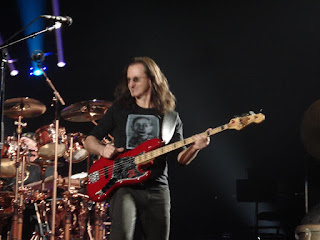
Part II:
As for Clockwork Angels, I haven't been able to get a handle on it for a couple of reasons. First is the brickwalled sound. Production-wise, this is Vapor Trails III, with each sequel getting heavier. I find it incredibly fatiguing to listen to. Additionally, so many of the tracks are so similar in tempo and structure that it sounds like one long song. At most I can only listen to half of the album. The Garden stands out a little bit, but there really isn't much variety. Furthermore, the triple-tracking pattern for the guitars and bass that they have adopted over the last three albums is just too much. Lyrically, its a bit too progressive in my opinion. It's far too dense and sci-fi-ish. This would almost work better as a book (oh, wait. It is). There have been criticisms on how thin the lyrics were on Presto (and in a few lines this is true, although it became far worse on the insipid and shallow Test for Echo). But here the density of the story put into verse is just too much, especially when combined with the density of the music. It also includes the worst, most vacuous phrase in English "it is what it is." I'll give it a little more time, but I'm hoping for a change of sound for the next album.
Rush @ Target Center, Minneapolis, MN, 2012.09.24
On this tour, Rush presented a different kind of setlist, (to the disappointment of the narrow-minded 70s fans) that included a lot of mid-80s tracks along with nine tracks off the new album Clockwork Angels. I would have liked a little more late-80s material (which was rotated on an alternating setlist), and I think there was still too much old material. The addition of the orchestra added more than I though it would, particularly on Manhattan Project, and it was interesting to the members integrate into the band and the rock-show.
+ : Subdivisions, Force Ten, Manhattan Project, Bravado
- : 2112, omissions of The Pass, Dreamline
View from the front row:


Part II:
As for Clockwork Angels, I haven't been able to get a handle on it for a couple of reasons. First is the brickwalled sound. Production-wise, this is Vapor Trails III, with each sequel getting heavier. I find it incredibly fatiguing to listen to. Additionally, so many of the tracks are so similar in tempo and structure that it sounds like one long song. At most I can only listen to half of the album. The Garden stands out a little bit, but there really isn't much variety. Furthermore, the triple-tracking pattern for the guitars and bass that they have adopted over the last three albums is just too much. Lyrically, its a bit too progressive in my opinion. It's far too dense and sci-fi-ish. This would almost work better as a book (oh, wait. It is). There have been criticisms on how thin the lyrics were on Presto (and in a few lines this is true, although it became far worse on the insipid and shallow Test for Echo). But here the density of the story put into verse is just too much, especially when combined with the density of the music. It also includes the worst, most vacuous phrase in English "it is what it is." I'll give it a little more time, but I'm hoping for a change of sound for the next album.
Sunday, September 23, 2012
Duluth Airshow 2012
Duluth IAP, MN, 2012.09.22
This year's airshow was very scaled back. There was no Air Force or Navy support (The F-16 demo team came to fly a few passes in the heritage flight - the gas, pilots and airframes were paid for - so if anybody can explain the AF's demo team stand-down to me, I can't figure it out), and the 148th didn't even fly, being mostly deployed to Afghanistan. That left the Marine's AV-8 demo, F-4, and the Canadian snowbirds. Statics were very light including the F-16, EF-18G, F-18, T-38, C-130 and the impressive C-5A. Weather was 37 degrees with high wind and rain, making quite a contrast to this summer.


Full Album
This year's airshow was very scaled back. There was no Air Force or Navy support (The F-16 demo team came to fly a few passes in the heritage flight - the gas, pilots and airframes were paid for - so if anybody can explain the AF's demo team stand-down to me, I can't figure it out), and the 148th didn't even fly, being mostly deployed to Afghanistan. That left the Marine's AV-8 demo, F-4, and the Canadian snowbirds. Statics were very light including the F-16, EF-18G, F-18, T-38, C-130 and the impressive C-5A. Weather was 37 degrees with high wind and rain, making quite a contrast to this summer.


Full Album
Thursday, September 13, 2012
Sound That Can't Be Made
Sounds That Can't Be Made - Marillion
"People change and they turn strange and so will I"
After the longest pause in output in Marillion's career, album 17 - Sounds That Can't Be Made has finally been finished. (Thanks to Marillion for providing me with the Mp3 album while my CD makes a transatlantic journey). Not being the biggest fan of the 2008 release Happiness is the Road, I have not committed as much time to absorbing the latest Marillion works, although I think 2007's Somewhere Else is an amazing record and is holding up as some classic Marillion work. There were difficulties with writers block as it seems that H has already said a lot of what he has to say, although it would seem unfortunate circumstances in his personal life have given him more to say. Even though there are many thematic repeats in his writing career, I think H is good at expressing the same stories in different ways. Some of the problems with making this record, I think, involve the 20 songs put onto Happiness is the Road. I would rather see single disc releases like this that take time than a massive and quick output. To begin with, Sounds has a title that is in my opinion is a bit awkward. I would have preferred something with a little more mystique, something simple like "Rain" would have been nice (there can't be enough Marillion songs about death and water.)
"Nothing's ever simple - that's for sure
There are grieving mothers on both sides of the wire"
"With the love of our family we can rise above anything
Someday surely someone must help us"
The standout track seems to be the opener Gaza - musically heavier and jarring, although somewhat disjointed. However I think this track is Marillion in top form, I can't get enough of it. From the orchestral beginnings, to the distorted guitars to the ethereal vocals this song is a dramatic story. Lyrically, this song has already produced heated controversy. People want to see it as anti-Isreal/Pro-Palestine/pro-terrorist. But I think this is to add a political/historic narrative that isn't present. This is rock music. This is art. This is revolution. It's about an oppressed population living in a war zone, particularly from a more innocent viewpoint. Really the controversy can only come from the title. Without a location name, it could be about any war. The meaning is not far from the Police's Invisible Sun, a song that only generated controversy from the British government. It is surely less ideological than Roger Water's anti-war songs like Leaving Beirut. H comes from a culture that is the dominant in a violent political conflict. Likewise, I, and many offended listeners from America, live in the dominant culture of a conflict. I don't want to see the US lose the "war on terror" and I don't think H wants the IRA blowing up London. But I think that we can look at reasons why these conflicts continue and understand that there are losers on both sides.
"Love had died but love is gonna live again"
Lyrically, the album as a whole is fairly simple and straightforward without much complex metaphor. Power is a strong track and was a welcome addition to the 2012 US tour, although I feel like some of the lyric/vocal transitions are a bit awkward. Pour My Love is a very nice track, a sad theme but presented in a positive and calm manner. It reminds me a bit of Prince (without any funk). Sounds That Can't Be Made , Montreal, Invisible Ink, and Lucky Man are perhaps less memorable lyrically but musically strong. The Sky Above the Rain presents another simple tale of lost love, it's not as epic or moving as I was led to believe, but it is well crafted and has great bluesy guitar work by Rothery.
There is in fact a lot of classic Rothery guitar sounds throughout the record. After their releases in the early 2000s I was beginning to worry that this had become history, but it is back in force. In all instrumental respects this album is musically intriguing and of sound quality. Musical phrases on this album leave me thinking about songs like Out of This World, The Space, Fantastic Place, This Strange Engine, Quartz and much of the Brave album. Although there are only eight songs, the album is 70 minutes long. There are a lot of musical bits, many of which I would like to see explored in longer sections. To be fair, I should give this album a few more weeks of listening before making judgements. But as I can't stop listening to it, I think that's good sign that this album will make its mark and overturn any disinterest I was beginning to feel with the last release. I can't wait for the next one.
Subscribe to:
Posts (Atom)


![The Brothers Karamazov [Norton Critical Edition]](https://i.gr-assets.com/images/S/compressed.photo.goodreads.com/books/1560399295l/49899120._SX50_SY75_.jpg)


